
The Dispatcher Bottleneck: How Mid-Market Service Companies Scale Past 25 Technicians
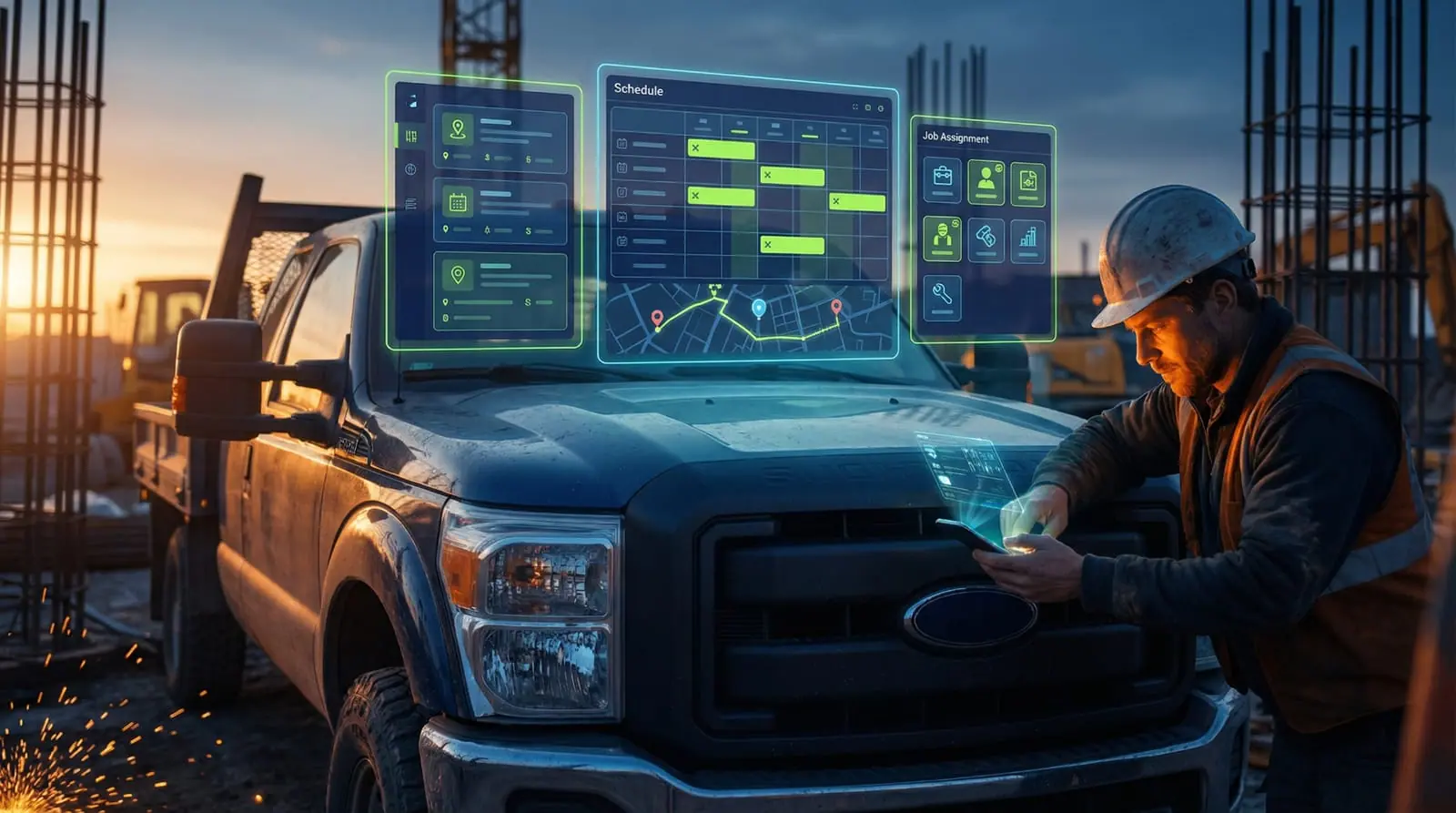
Quick answer: Field service businesses scale operations without adding dispatchers by replacing manual whiteboard scheduling with constraint-solving AI dispatch. Manual ratios cap at roughly one dispatcher per eight technicians; AI scheduling absorbs 60–70% of routine decisions and lifts the ratio toward 1:25. ServiceIQ runs autonomous dispatch with human override at the inflection point around 25 techs.
Key Takeaways
- ●Manual dispatch breaks at ~25 technicians, predictably.
- ●Dispatcher-to-tech ratio: 1:8 manual → 1:25 with AI.
- ●"AI scheduling" means constraint solving, not rule suggestions.
- ●ServiceIQ runs autonomous dispatch with full human override on a drag-and-drop board.
The math of dispatcher-to-tech ratio
Manual whiteboard or spreadsheet dispatch holds together at one dispatcher per eight technicians. Above that, the dispatcher cannot mentally model skill, location, parts, traffic, and SLA simultaneously across the open board. The first symptoms are missed-SLA rate, dispatcher overtime, and dispatcher turnover, in roughly that order.
AI scheduling absorbs the routine decisions: simple service calls, maintenance contract slots, geographically obvious pairings. That frees the dispatcher to focus on exceptions, VIPs, and same-day disruption, and lifts the supportable ratio toward one dispatcher per twenty-five technicians. On a 50-tech operation, that is the difference between six dispatchers and two.
AI scheduling places the job; it does not suggest it
Most marketing-grade "AI scheduling" is a rules engine with suggestions on top. Real AI scheduling is constraint solving: a solver that evaluates every candidate assignment against the full set of constraints (skill, location, parts, SLA, traffic, customer preference) and proposes the assignment with the lowest total disruption cost.
The difference matters at scale. A rules engine produces obviously-good assignments and obviously-bad ones. A constraint solver produces optimal assignments across the entire board, re-solved every time something changes.
Where humans still belong
Autonomous dispatch still needs a dispatcher. What changes is what they spend the day on: VIP customers, escalations, same-day catastrophes, contract negotiations: the calls that need judgement. A 1:25 dispatcher-to-tech ratio works precisely because nobody is hand-placing routine work any more.
ServiceIQ presents AI assignments as recommendations on a drag-and-drop board. Every override is preserved and audited. The dispatcher can pin an assignment, lock a tech to a customer, or freeze a portion of the board.
The ServiceIQ autonomous dispatch implementation
The constraint solver runs continuously against the open board. Inputs include the four routing inputs (traffic, SLA, skill, parts), territory boundaries, on-call rotations, customer preferences, and pipeline-aware logic. When a same-day call drops in, the engine proposes the assignment with the lowest total disruption, and explains why.
Conflict detection is built in: travel-time-aware booking refuses to schedule a tech into a slot that overlaps prior travel; double-booking is flagged before save. Drag-and-drop overrides are preserved and audited.
Growth-stage decision framework
Technician count is the number everyone quotes, and it is the wrong one. The signal lives in four secondary metrics:
- →Missed-SLA rate above 5%.
- →Dispatcher overtime sustained above ten hours per week.
- →Dispatcher turnover (the canary: burnout shows up in resignations first).
- →Same-day add-on absorption falling: the board is too full to flex.
Ready to take on more premium projects without adding to your overhead?
Lock in your flat-rate, unlimited-user fee with ServiceIQ today.
Start your free trialFrequently asked questions
Keep reading
Reduce Technician Drive Time by 30%
AI-driven dynamic routing cuts field technician windshield time 25–35%. See the four inputs, the math, and how the ServiceIQ routing engine continuously re-solves your fleet.

Emergency Dispatch Done Right
Emergencies break weak dispatch tools. Here is the operational pattern, and the software behavior, that absorbs urgent calls without imploding the day.

Radios and Group Texts Kill Margins
A single dispatcher–technician miscommunication costs $400–$1,200 per incident. Unified inbox communication recovers it. See how ServiceIQ's communication hub works.
Ready to take on more premium projects without adding to your overhead?
Lock in your flat-rate, unlimited-user fee with ServiceIQ today.
Start your free trial