
Strategic Business Frameworks That Work for Construction Businesses
Quick answer: A real EOS Worldwide case study shows what happens when a construction company between $5 million and $20 million in revenue puts structure under a business that still runs through one owner. Clarity of direction, real accountability, a weekly scorecard, root-cause problem solving, and quarterly focus took decisions off the owner's desk. The framework fixes who decides. A shared system for schedules, approvals, and job status is what fixes who actually knows what's going on.
Key Takeaways
- ●A mid-sized construction company case study from EOS Worldwide walks through what happens when a business between $5 million and $20 million in revenue stops running through one person and puts real structure underneath it.
- ●The five shifts were clarity of direction, real accountability with one owner per function, a weekly scorecard of leading indicators, solving problems at the root, and a small number of real quarterly priorities.
- ●EOS is one entry point into this category, not the only one. Scaling Up and OKRs cover similar ground with different vocabulary.
- ●A framework fixes who makes which decision. It doesn't fix who's the only one who actually knows what's going on, which is a separate, quieter bottleneck.
- ●Getting the schedule, approvals, and job status into one shared system is what actually takes the owner out of the role of human relay switch.
The Company
Picture the owner of a mid-sized construction company on a Tuesday. He's approving a change order at 7am, standing in for an estimator who called in sick at 9, refereeing a disagreement between the PM and the super at 11, and somehow still expected to think about next year's growth plan before the day's out. The business is doing well, technically. Revenue's up. The backlog is strong. And somehow it all still runs through him, personally, all day, every day.
That's not a failing business. That's most construction businesses somewhere between $5 million and $20 million, and it's exactly the moment where the thing that built the company (the owner doing everything) starts being the thing that's holding it back.
A real case, published by EOS Worldwide, walks through what happens when a company in exactly that spot decides to actually fix it, not with more hustle, but with structure.
The case study describes a family-owned construction business in Central Florida, a strong reputation in the Orlando market, long-standing clients, a solid team. By most measures, successful. But leadership meetings weren't producing decisions, just conversations that moved from topic to topic and resolved nothing. Roles had evolved without ever being clearly defined, so responsibilities overlapped and things fell through the gaps between them. Margins were inconsistent, and nobody could pin down why quickly enough to fix it mid-project. The owner was still hands-on in estimating and day-to-day decisions, the same way he'd been since the company was a fraction of its current size.
The constraint wasn't the market. Central Florida construction was still growing. The constraint was that the business had outgrown the structure holding it up.
They implemented EOS® (the Entrepreneurial Operating System®, the framework laid out in the book Traction®) to put some actual bones under the operation. Here's what changed, in the order it happened.
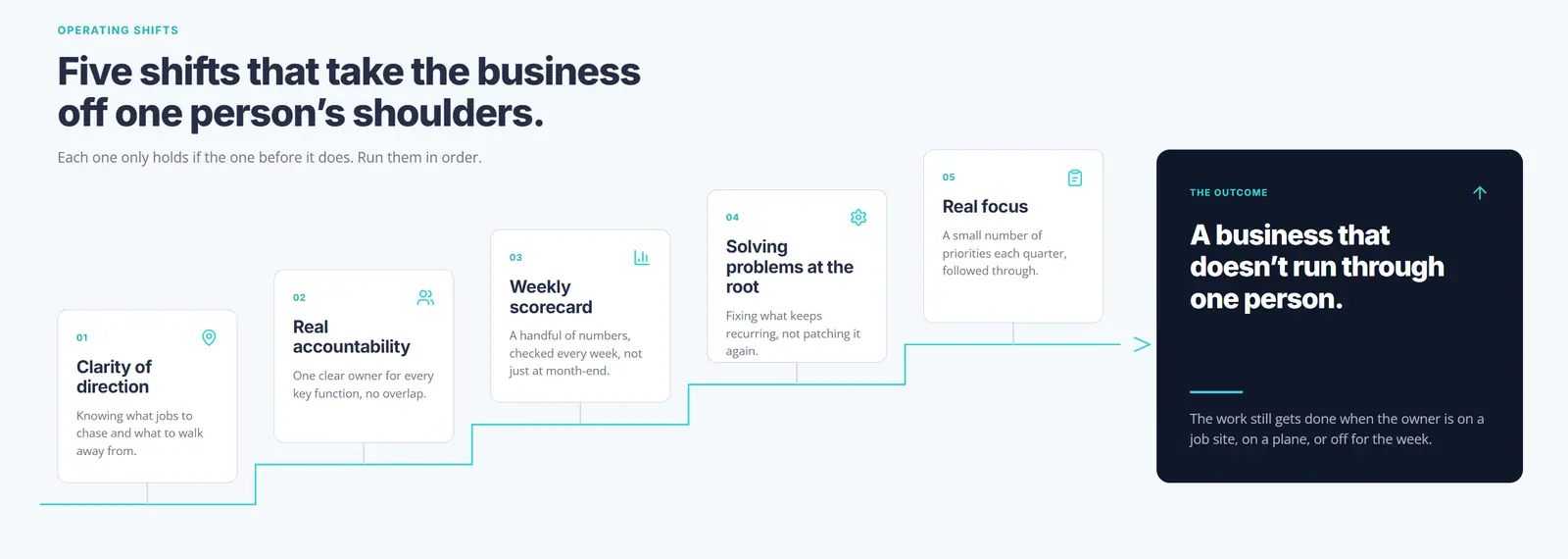
The Five Shifts
- Clarity of direction. Leadership actually aligned on where the company was going and what kinds of projects they wanted to chase. Sounds obvious. Most companies never do this out loud, which is exactly why they end up chasing whatever job walks in the door instead of the ones that fit.
- Real accountability. Estimating, operations, project management, finance: each got one clear owner. Not "mostly handled by," an actual owner. That alone cut out most of the overlapping-responsibility mess.
- A weekly scorecard, tracking leading indicators. Not just the financials at month-end, but conversion rates, project timelines, job performance, the numbers that tell you something's going wrong while there's still time to do something about it. This is the part that should land well with anyone running a construction business: it's not a vibes-based vision exercise, it's hard numbers, checked weekly.
- Actually solving problems at the root, instead of patching the same issue every few weeks. The case study notes this was the most meaningful shift of all, the discipline to stop and ask why something keeps happening instead of just handling it again.
- Real focus. A small number of priorities each quarter, followed through on consistently, instead of eleven priorities that all quietly compete with each other and mostly lose.
Implementation of the Framework
The business kept growing, but differently. Decisions that used to land on the owner's desk got made in the room, without waiting for him. Leadership could see a problem in the numbers days before it would've shown up as a bad month. Meetings actually ended with someone doing something, not just another meeting scheduled to talk about it more.
Nobody set out to have better meetings. The real goal was a business that could take on the next job without adding it straight to the owner's own plate.
EOS Isn't the Only Door Into This Room
EOS gets the most airtime because Traction sold a lot of copies, but it's one entry point into a broader category, not the only one. Scaling Up (Verne Harnish's framework) covers similar ground with a different vocabulary. OKRs, borrowed from the tech world, do a version of the "quarterly focus" piece on their own. The specific framework matters less than the underlying habit: write the plan down, assign real ownership, check real numbers on a real schedule, and stop letting the same problem quietly resurface every quarter.
Most construction businesses never get introduced to any of these, because nobody ever framed them for a construction business instead of a tech startup or a consulting firm's own internal operations.
The Other Thing You Have to Let Go Of
A framework fixes who's allowed to make which decision. It doesn't fix who's the only one who actually knows what's going on.
That second problem is quieter, but it's just as much of a bottleneck. If the schedule only lives in the owner's head, if the latest drawing revision is a photo he texted someone last Tuesday, if the crew has to call him just to find out whether a change order got approved, the org chart doesn't matter. He's still the switchboard everything routes through.
This is where a platform like ServiceIQ earns its place alongside a framework, not instead of one. When the schedule, the approvals, and the job status all live in one place everyone can already see, the owner isn't the one relaying information anymore. He's the one checking that the system's working. That's a real shift in what the job actually is: less middleman, more overseer.
Nobody puts "human relay switch" on a business card. It's just the job a lot of owners end up doing anyway, one text message at a time, until something finally takes that job off their plate instead.
Structure gets you out of the weeds. The right tools keep you out of them.
Source
Ready to take on more premium projects without adding to your overhead?
Lock in your flat-rate, unlimited-user fee with ServiceIQ today.
Start your free trialFrequently asked questions
Keep reading
The Misplaced Mission
You didn't get into contracting to debug software. Here's how DIY app-building quietly turns a construction CEO into an unpaid product manager, and what to do about it.

Job Costing for Profitability
A controller's guide to construction job costing: direct vs. indirect costs, committed costs, the 10-step estimating process, and the WIP reporting that reveals over- and under-billing.

What Is ServiceIQ?
ServiceIQ is a governed field service platform that helps HVAC and plumbing companies dispatch faster, cut callbacks, and turn every job into an auditable record.
Ready to take on more premium projects without adding to your overhead?
Lock in your flat-rate, unlimited-user fee with ServiceIQ today.
Start your free trial