
Strategic Roadmap: Unifying Construction Data for Real-Time Operational Intelligence
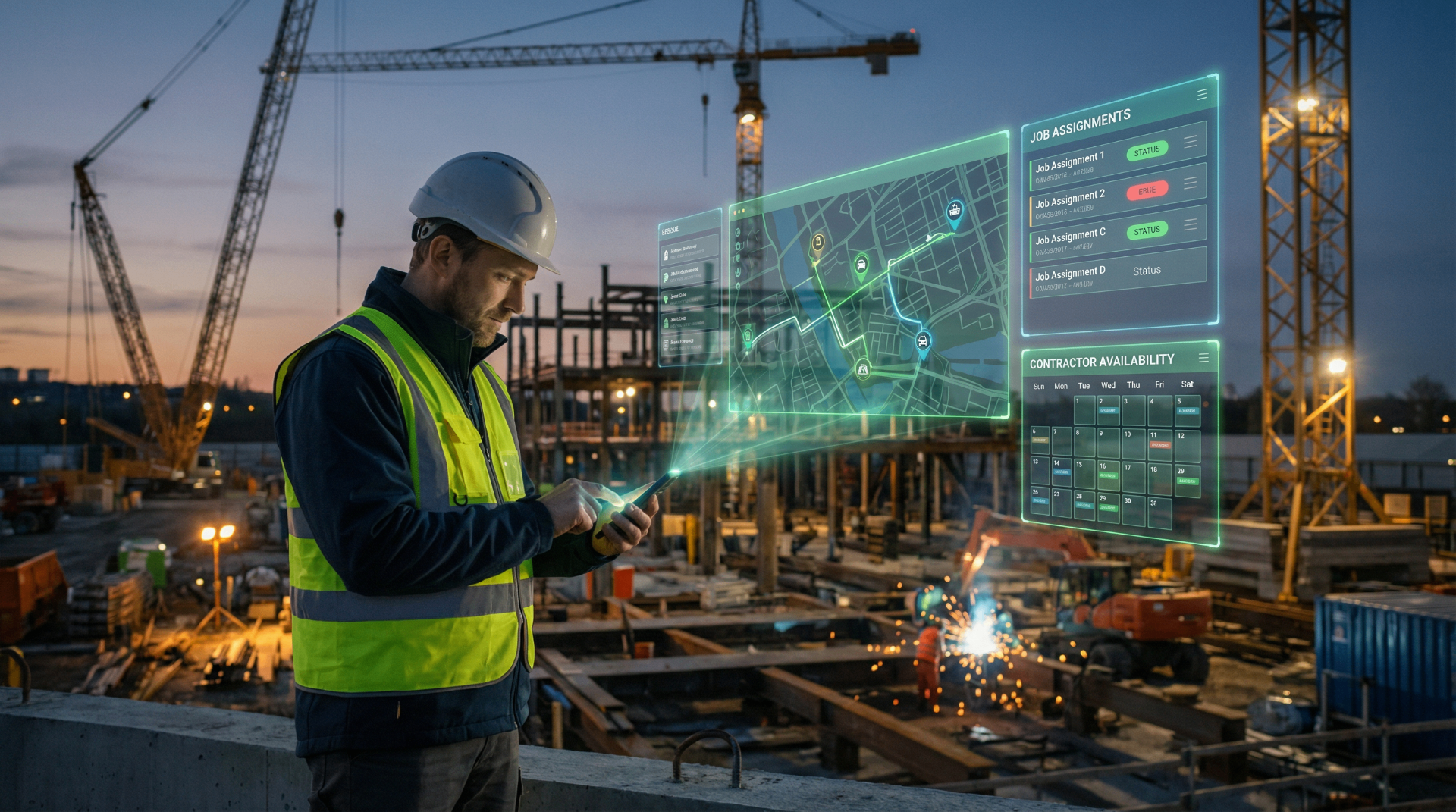
Quick answer: Digital infrastructure is now the primary buffer against VUCA market pressure on hyperscale construction. Firms that still layer AI onto fragmented reporting keep optimizing tasks while interaction risk between 40+ subcontractors keeps compounding. The winning shift is from a hoarded 'Single Source of Truth' to a shared 'Truth for Everyone' model: an integrated PMIS/ERP spine that turns 18,000 paper entries into 80,000+ real-time signals, replaces monthly whip reports with daily cost-to-complete, and gives leadership one pane of glass to orchestrate people, machines, and money before conditions on the ground change.
Key Takeaways
- ●Interaction risk from 40–50 stacked trades is the largest hidden liability on hyperscale builds.
- ●A single arc flash event runs $15–25M; a 60MW facility bleeds $14M per month of coordination delay.
- ●Discrete workflow AI underperforms: system-wide orchestration is what actually reduces risk.
- ●'Truth for Everyone' beats a hoarded 'Single Source of Truth' by removing your-facts-vs-my-facts friction.
- ●Integrated PMIS/ERP turns lagging monthly reports into a daily Real-Time Whip on cost-to-complete.
- ●Robotics, digital twins, and voice-to-data tools automate the Dull, Dirty, and Dangerous, reducing drudgery and attracting talent.
The Digital Buffer Against VUCA
The construction industry is navigating a high-stakes transition from its paper-based heritage to a digital future. This shift is not a routine IT upgrade; we must deploy digital infrastructure as the primary strategic buffer against 'VUCA' market conditions: volatility in pricing, uncertainty in labor, changing designs, and pervasive ambiguity.
In this landscape, the project's greatest threat is the 'interaction risk' generated by the friction between 40 to 50 independent subcontractors working in compressed, energized environments.
The High Cost of Coordination Failure
On modern hyperscale builds, coordination failures represent catastrophic financial and safety exposures. The numbers make the case louder than any pitch deck.
- →Interaction Risk and Trade Stacking: compressed timelines force structural, mechanical, and electrical teams into the same work zones, stacking compounds schedule pressure and cascading failure risk.
- →Life-Safety Failures: a single major arc flash event runs $15M–$25M including injury liability, equipment replacement, and litigation.
- →Monthly Delay Penalties: for a 60MW facility, coordination-driven delays can cost $14M per month.
- →Operational Friction: field foremen waste hours solving planning problems while crews wait for access or materials staged out of sequence, the 'drudgery' tax.
Evaluating Current Limitations
While AI adoption is accelerating, a gap remains between tool deployment and coordination infrastructure. Most firms engage in Discrete Workflow Optimization, applying AI to isolated tasks. Layering automation onto fragmented reporting underperforms because it ignores the systemic risk of crew interactions.
True transformation requires moving beyond 'stored paperwork' toward System-Wide Orchestration, using digital data to inform decisions before conditions on the ground deteriorate.
Transitioning to the 'Truth for Everyone' Model
Strategic data management requires a shift from a 'Single Source of Truth', often a siloed model where data is hoarded, to 'Truth for Everyone.' This transparency-based model ensures owners, GCs, and trades operate from a shared set of facts.
The result: less litigious tension, and 'your facts vs. my facts' collapses into one set of actionable data.
Defining the Integrated Architecture
The shift from legacy silos to integrated PMIS/ERP systems is measured by visibility and efficiency. Legacy state means 18,000 manual paper entries, monthly cost-to-complete reports built on lagging data, and static binders for visibility.
Integrated state means 80,000+ digital entries with real-time feedback loops, automated data feeding from other applications, daily updates of transactions and encumbrances, the Real-Time Whip, and dynamic one pane of glass visibility via PowerBI-style dashboards.
The PMIS as the Central Spoke
To eliminate interaction risk, the Project Management Information System (PMIS) must serve as the integration hub. The value of this model is proven by Universal Group (Canada): by digitizing submissions, they saw entries jump from 18,000 to 80,000 in a single year, because the field realized the office was actually reading the data and responding to mechanical issues in real time.
By serving as the spoke between the ERP (financial truth) and field operations (operational truth), the PMIS reduces manual keystrokes and moves leadership from reactive reporting to proactive orchestration.
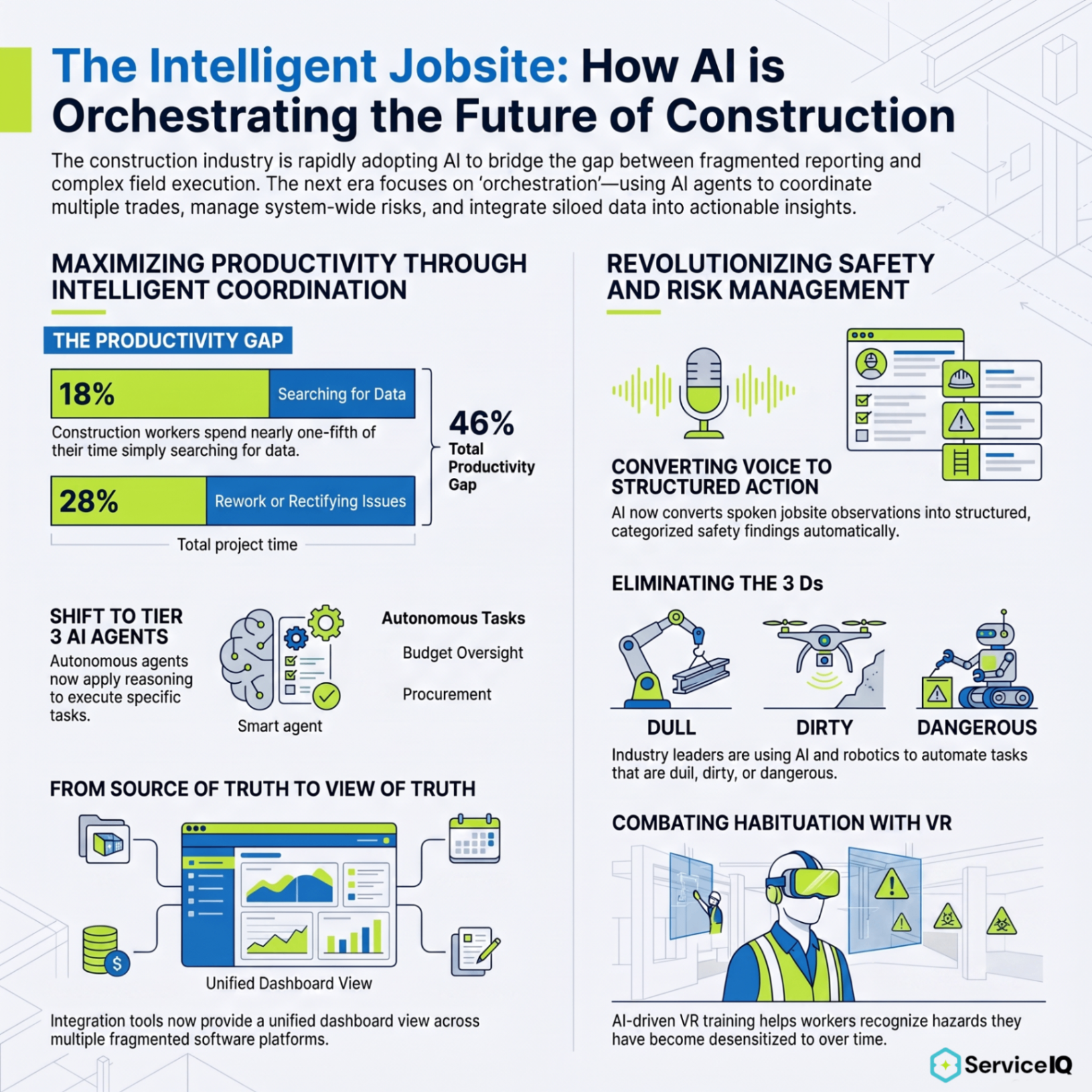
The Intelligent Jobsite at a Glance
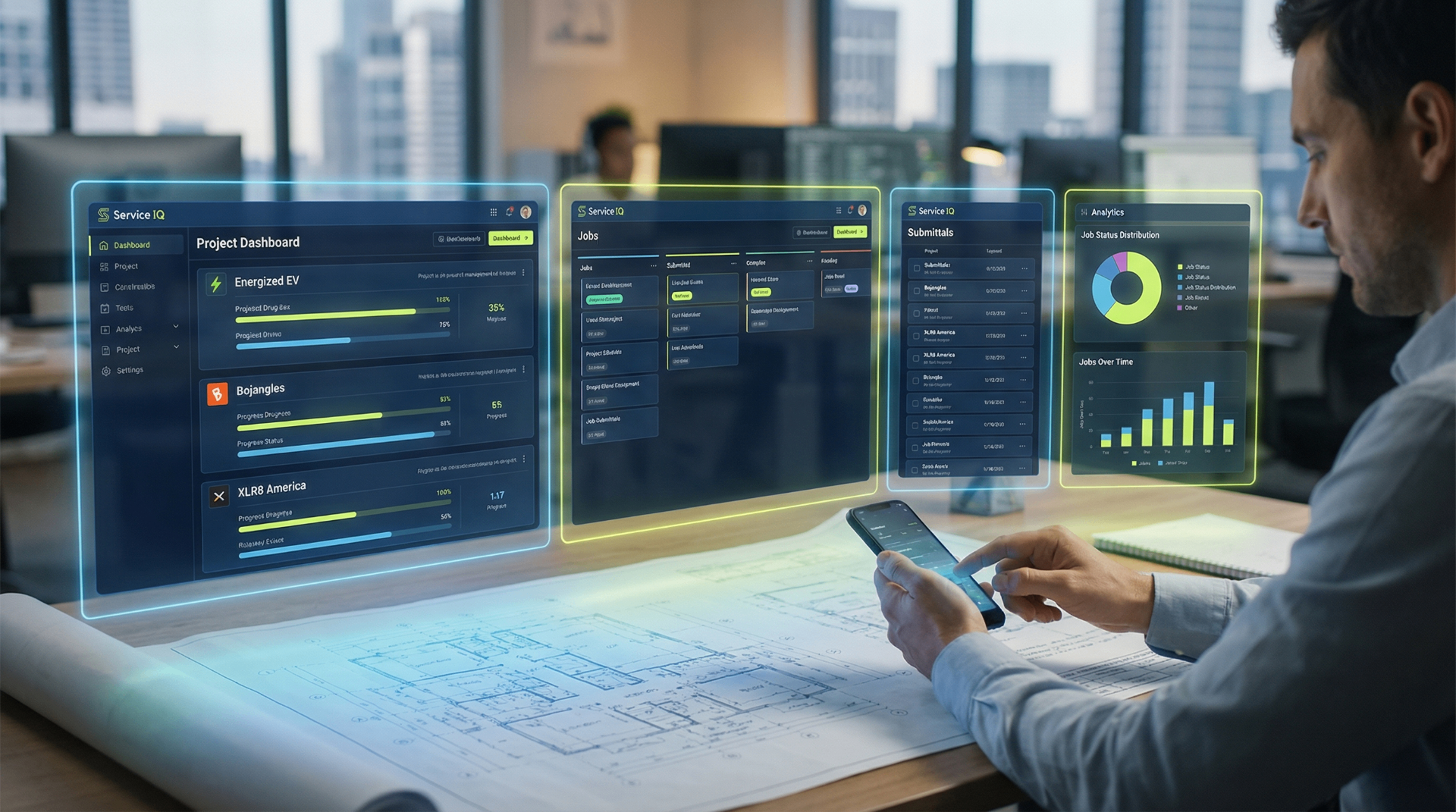
How AI is orchestrating the future of construction: productivity, safety, and coordination in a single view.
From Monthly Reports to Daily Intelligence
Legacy planning that loads costs every three months is obsolete. Integrated systems change the tempo of decision-making across three dimensions.
- →Real-Time Transactions: instant visibility into actual transactions and encumbrances.
- →The 'Real-Time Whip': daily cost-to-complete visibility that lets project managers identify troubled projects immediately.
- →Dynamic Allocation: knowing exactly 'how much money is left in the pot' daily, owners can confidently advance the next set of capital projects.
Mitigating Productivity Drain
Integrated preconstruction is the primary driver of productivity gains. Currently, 18% of project time is wasted searching for data and 28% on rework.
Providing a 'one pane of glass' view ensures teams work from the latest designs, mitigating the $14M monthly delay costs associated with miscoordinated trades.
Operationalizing Field Data: Safety, Robotics, and AI
Transformation turns every worker into a 'safety agent' by using mobile and AI tools to create 'a million eyeballs' on the jobsite, feeding risk data into a central model.
We must move from 'stored paperwork' to operational intelligence. Tools like Highwire's AI Findings for Inspections let field teams dictate observations that the AI converts into structured findings with assigned risk levels. Safety leaders then prioritize their presence based on actual risk patterns and zone-level activity density rather than just following a schedule.
Robotics and Visual Intelligence
Physical AI provides measurable offsets to labor shortages and interaction risks. Layout robots complete work 10x faster than manual methods. Remote-operated cranes lift 10% more efficiently and improve operator safety.
Digital twins provide a visual copy of the site for quality and progress checks with minimal human oversight, and autonomous equipment automates the Three Ds (Dull, Dirty, or Dangerous) to reduce hazard exposure.
Culture, Upskilling, and the Burnout Crisis
While 42% of construction leaders see upskilling as a primary impact of transformation, there is a significant 'pull' factor: 45% of workers cite technical skills as the capability they most want to develop.
Digital tools are a direct strike against the $14M monthly delay costs caused by worker exhaustion. At one utility firm, field workers spent 3 hours of overtime nightly typing notes, voice-to-data tools eliminate that drudgery, improving work-life balance and retention.
Following the Rogers-O'Brien model, we automate the Dull, Dirty, and Dangerous to promote purposeful work and attract young, enthusiastic talent, while remote work technology and mobile connectivity let teams disconnect once the job is done.
The Future State of Construction
The future of construction belongs to those who move from reactive data collection to proactive orchestration. The goal is to harmonize people, machines, and data into a single, clearer operational picture.
- →Orchestration over Automation: automation in isolation creates blind spots. The real job is orchestrating complex interactions between 40+ trades and energized systems.
- →Data as a Silent Partner: integrated data compounds in value. Build a 'data lake' and historical performance becomes predictive analytics.
- →Transparency as Trust: 'Truth for Everyone' lets us argue over one set of facts, strengthening relationships between owners, GCs, and trades.
What You Need to Know About AI in Construction, Today
Three free infographics distilling the orchestration playbook (trade stacking, PMIS/ERP integration, and the Truth-for-Everyone data model) into a single visual download.
Download the free infographicsReady to take on more premium projects without adding to your overhead?
Lock in your flat-rate, unlimited-user fee with ServiceIQ today.
Start your free trialFrequently asked questions
Keep reading
The Misplaced Mission
You didn't get into contracting to debug software. Here's how DIY app-building quietly turns a construction CEO into an unpaid product manager, and what to do about it.
The Credit Trap
Generative AI coding tools make it feel like you built your own construction platform in a weekend. Here's why that 'weekend genius' project usually ends up costing more than the software it was supposed to replace.

What Is ServiceIQ?
ServiceIQ is a governed field service platform that helps HVAC and plumbing companies dispatch faster, cut callbacks, and turn every job into an auditable record.
Ready to take on more premium projects without adding to your overhead?
Lock in your flat-rate, unlimited-user fee with ServiceIQ today.
Start your free trial