
You Can't Ban Your Way Out of Shadow AI

Quick answer: The construction industry can't ban its way out of employees using AI tools. Data from AGC Tech 2026 and outside industry surveys agree: blocking access just pushes usage onto personal devices where there's no visibility at all. The fix is a short, real policy, a shared knowledge base, and a sanctioned tool people actually want to use.
Key Takeaways
- ●46% of employees say they'd keep using AI tools even if their company banned them outright, and 59% are already using unapproved tools versus just 16% using anything sanctioned.
- ●Restriction without trust backfires. 89% of employees already know their company's AI rules, and most use unsanctioned tools anyway.
- ●Firms doing AI in the open are seeing real results, including a 20% drop in material waste at Balfour Beatty and a 17% shorter average project duration on ALICE Technologies deployments.
- ●43% of companies have no AI policy at all, and a one page document is the easiest gap to close.
- ●Giving employees an approved, sanctioned AI tool drops unauthorized usage by 89%, according to a 2026 Healthcare Brew survey.
Bans Only Blind You From the Truth
At AGC Tech this year, a topic kept resurfacing in any room: how do we stop our people from using ChatGPT? It came up during Ask the Experts. It came up again, more bluntly, over drinks at the Crowd Source Solutions Bar. And nearly every time, the proposed fix was the same: lock it down. Block the domains. Pull the access. Solved.
Here's the problem with that plan: it doesn't work. Not "doesn't work well." Doesn't work, period, and the numbers on this are not close.
46% of employees say they'd keep using AI tools even if their company banned them outright (Software AG, 2024). Not "might." Would. Meanwhile, 59% of employees are already using AI tools their employer never approved, while only 16% are using anything the company actually sanctioned (Awareways Trend Report, 2025). That gap, 59 versus 16, is the whole story. The behavior isn't restricted to the construction industry either. It's across all businesses, and the idea that a stricter policy will solve it isn't going to hold up.
And if you want proof that surveillance and restriction don't work on people, Amazon's warehouses have been running that experiment for years. Ask them how it's going.
So what does banning actually accomplish? It moves the activity somewhere you can't see it. Employees stop using AI on a monitored work laptop and start using it on a personal phone, on a personal account, with zero visibility into what data went where. You haven't reduced the risk. You've created an environment where using AI has become a guilty pleasure, an AI version of the movie Footloose. Your staff go underground, tapping on their "illegal" ChatGPT to a Kenny Loggins soundtrack. And the worst part is you've just made yourself blind to it, which, if you're the person whose job is managing that risk, is arguably worse than where you started.
Treat Your Crew Like They Can't Be Trusted, and They'll Prove You Right
Here's the thing about construction specifically, and it's worth saying plainly: this is an industry built on trusting people with dangerous tools. You don't hand a new hire a nail gun and then lock every board in a shed because you're worried what they'll do with it unsupervised. You train them on it. You show them the right way, the wrong way, and what happens if they skip the safety glasses. Then you trust them to use it.
Somewhere between the jobsite and the back office, that logic gets abandoned. A crew gets trusted with power tools, forklifts, and bulldozers on day one. An estimator gets treated like a liability the moment ChatGPT is open in another tab. That's backwards, and it comes at a real cost: 89% of employees already know the rules around AI usage at their company, and the majority use unsanctioned tools anyway (Awareways, 2025). Restriction without respect produces people who've quietly decided the rule doesn't apply to them.
The fix isn't a stricter memo. It's treating your team like professionals who can be trusted with a tool, the same way you already do with every other tool on the job.
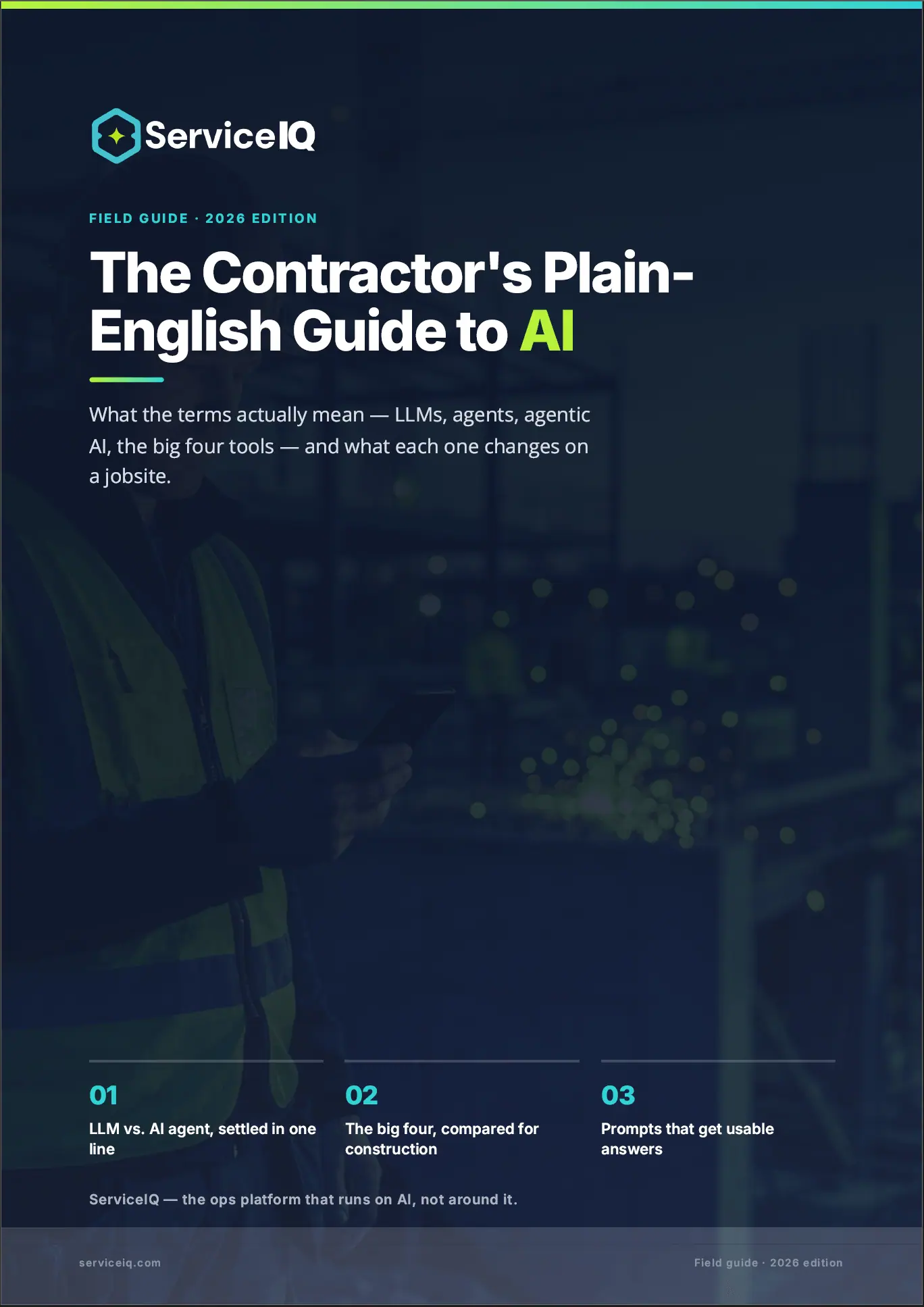
Want to Know More About AI Shadow and Other Terms?
Get the plain-English breakdown of LLMs, AI agents, and the other terms getting thrown around every jobsite trailer and IT meeting right now, free.
Read the FREE eBookWhat Happens When This Gets Done in the Open, Not the Shadows
While some rooms at AGC Tech were debating how to lock AI down, companies outside were quietly showing what happens when it's done out in the open instead:
- →Balfour Beatty, one of the largest construction firms in the world, used predictive analytics for resource forecasting and posted a 20% drop in material waste, with budget targets hit at 94% accuracy.
- →ALICE Technologies' AI scheduling platform has been deployed on projects worth over $100 billion, delivering an average 17% shorter project duration and 14% lower labor costs.
- →Firms using AI-based computer vision for jobsite monitoring have seen safety incidents drop by roughly 20% on average, per Deloitte research, with some individual firms reporting 40 to 50% reductions.
- →Pilot firms automating field reports, invoicing, and dispatching report 30 to 50% reductions in admin hours, which is, not coincidentally, the exact problem an agentic platform like ServiceIQ is built to chip away at.
So What Do You Actually Do Instead?
Worth remembering the stakes here too: McKinsey puts the average large construction project at roughly 20% over schedule, and industry-wide schedule delays cost the sector an estimated $1.6 trillion in 2024 alone. That's the size of the problem AI is actually being aimed at, a much bigger number than whatever risk a locked-down IT policy is trying to manage.
Look, we're not saying do "nothing." The answer to "banning doesn't work" isn't "no guardrails." It's about building the right guardrails, with your team. The whole idea that IT is siloed away in the dark basement isn't something we should be promoting.
- Write an actual policy, one page, plain English. Not a 40-page document nobody reads. Include what tools are approved, what data can never go into a public AI tool (client contracts, pricing, anything under NDA, personal information), and who to ask if something's unclear. 43% of companies currently have no AI policy at all. This is the single easiest gap to close, and it costs nothing but an afternoon.
- Build a shared knowledge base, not a rulebook. Get estimating, project management, and the back office each contributing what's actually working for them. Think about creating a shared prompt library: the prompt that saved someone two hours, or the tool that caught an error before it became a change order, are all worth passing along. The goal is employees teaching each other.
- Give people something better than the thing you're trying to stop. This is the stat that should end every "should we block ChatGPT" conversation before it starts: providing an approved, sanctioned AI tool drops unauthorized usage by 89% (Healthcare Brew Survey, 2026). People aren't using unapproved tools out of rebellion. Nobody gave them a sanctioned option that actually works. Fix that, and the shadow problem mostly solves itself.
- Make security a floor, not a wall. A short approved-tools list. A clear line on what data category can go where. A named person to flag concerns to, no blame, just a fast fix. That's a governance structure a team can actually work within, instead of one they route around.
The Real Risk Was Never the Tool
Every example above comes down to the same move. Trust the crew. Train them. Get out of the way. That's it. That's the whole memo.
Not all superheroes wear capes. Sometimes it's just the GC who understands their people.
That's the bet ServiceIQ is built on too: an AI agent, because we'd rather build something people actually want to use than something IT has to enforce. Your team's probably already using AI one way or another. Might as well make it something you can see, instead of something you have to guess at.
Ready to take on more premium projects without adding to your overhead?
Lock in your flat-rate, unlimited-user fee with ServiceIQ today.
Start your free trialFrequently asked questions
Keep reading

Why Your AI Strategy is Failing the Jobsite
AI adoption on construction is at "whip speed," but the coordination gap is widening. Five truths on why AI underperforms on the jobsite, and how to bridge deployment and execution.

The Field Test
A dashboard that looked perfect on Sunday can be dead on arrival Monday morning. Here's why AI-generated contractor apps break the moment they leave the office, and what a real field-ready platform looks like.
AGC Tech 2026 Recap
Notes from the AGC Technology Conference, August 4–6 in Minneapolis: AI bootcamps, a back-office agent named Wendy, and why construction has stopped asking whether to use AI and started asking how.
Ready to take on more premium projects without adding to your overhead?
Lock in your flat-rate, unlimited-user fee with ServiceIQ today.
Start your free trial