
Why Your AI Strategy is Failing the Jobsite: 5 Truths About Construction’s Coordination Crisis
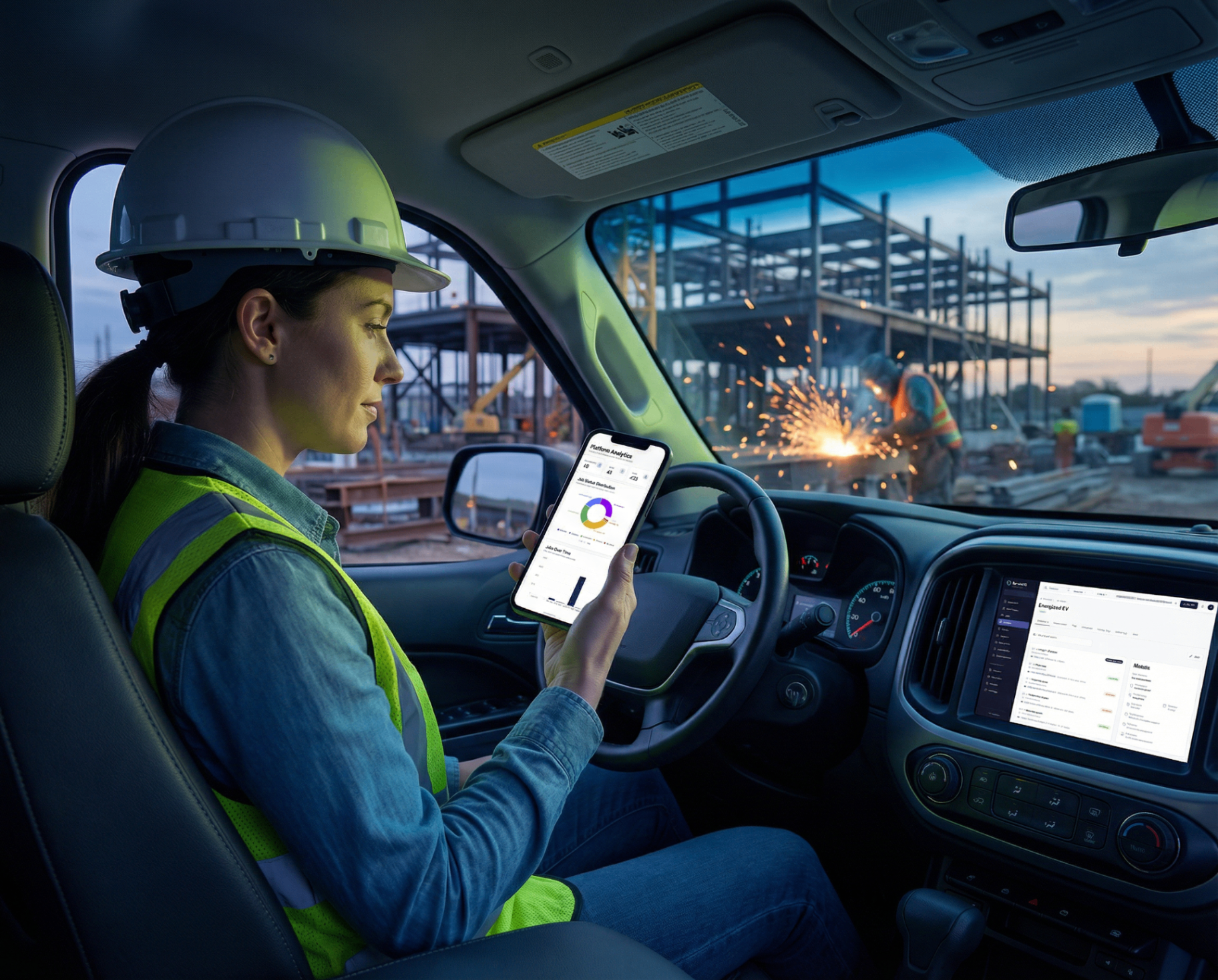
Quick answer: AI is being adopted on jobsites at whip speed, but the coordination gap on hyperscale builds is widening, not closing. The reason: firms are layering discrete-workflow AI onto fragmented, siloed processes. AI is an optimizer, not a conductor. Value only appears when there is a shared operational picture, integrated PMIS/ERP data, and a coordination infrastructure that turns pre-task plans and field observations into pattern-matched intelligence instead of stored paperwork.
Key Takeaways
- ●AI is optimizing discrete tasks while system-level coordination decays. The gap is widening, not closing.
- ●Modern jobsites are VUCA (Volatile, Uncertain, Changing, Ambiguous). The dominant hazard is Interaction Risk, not individual error.
- ●Trade stacking on hyperscale builds runs $15–$25M per arc flash event and $14M/month in delay on a 60MW facility.
- ●Adoption is a human feedback loop: Universal Group's digital submissions jumped from 18,000 to 80,000+ in a single year because the office actually responded.
- ●18% of project time is spent searching for data; 28% is spent on rework. The Visibility Gap is the real cost line.
- ●'Transparency for Everyone' beats the myth of a hoarded 'Single Source of Truth.'
- ●The future builder is a digital-twin orchestrator, humans directing robots and sensors, multiplying field experience rather than replacing it.
The Coordination Gap Is Widening
In the last decade, construction has decisively shed its reputation as a technology laggard. Firms are adopting digital tools at what industry experts on the Kahua Build Different podcast describe as 'whip speed.' Yet a persistent irony remains: as we add more technology, the coordination gap on complex, hyperscale builds is actually widening.
On a modern project site, a superintendent can collect hundreds of pre-task plans (PTPs) in a single day. Without a robust system to analyze those plans for overlaps or recurring hazards, they become nothing more than 'stored paperwork instead of operational intelligence.' Many organizations are layering advanced AI onto fragmented, siloed processes, expecting the technology to fix a coordination crisis it was never designed to solve alone.
1. AI Is an Optimizer, Not a Conductor
Current AI tools, from autonomous equipment to computer vision, have reduced worker exposure on individual tasks. But they are designed to optimize discrete workflows: single tasks performed in isolation.
That creates blind spots at the system level. AI may optimize a specific trenching operation, but it cannot inherently account for the interaction between multiple crews or the risks posed by energized systems being commissioned in phases around active construction. AI produces genuine value only when there is a shared operational picture across project leadership. Without that orchestration layer, technology generates noise instead of intelligence.
2. Interaction Risk and the VUCA Reality
To understand the modern jobsite, project leaders must embrace VUCA: Volatile pricing, Uncertain weather and labor, Changing designs, and Ambiguous outcomes. This environment has shifted the risk profile away from individual human error toward Interaction Risk, the hazard created when multiple crews and systems operate simultaneously in the same environment.
It is most visible in trade stacking. Compressed timelines on projects with upwards of 6,000 workers force independent crews into the same corridors at the same time. When these teams are not fully aligned, the financial and safety stakes are catastrophic.
- →Arc flash exposure: a single major event costs roughly $15M to $25M in injury liability, equipment replacement, regulatory fines, and litigation.
- →Schedule exposure: on a hyperscale build, delay alone can run $14M per month for a 60MW facility.
- →Cascading failure: a delay in one team creates knock-on failures no siloed AI tool can predict.
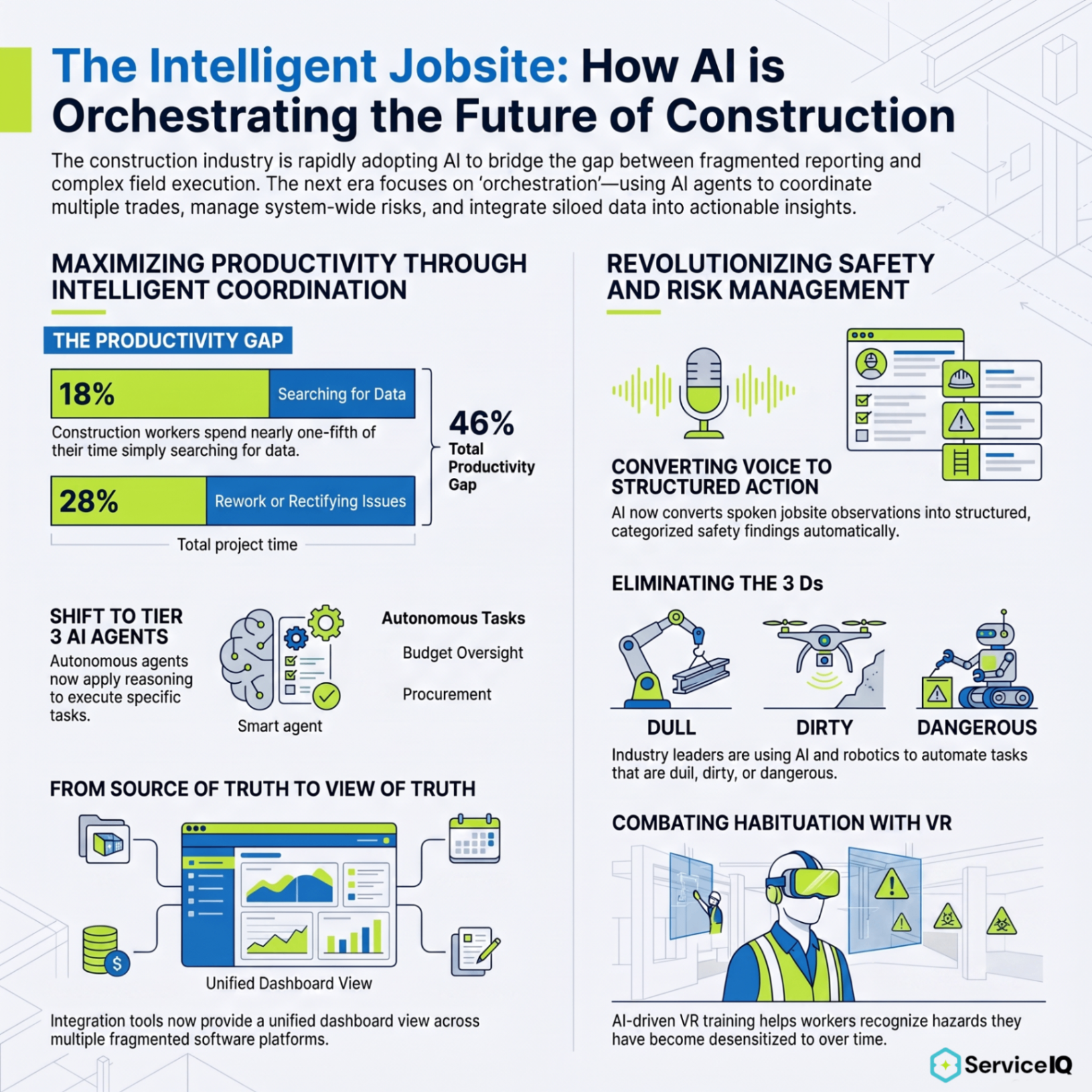
The Intelligent Jobsite at a Glance
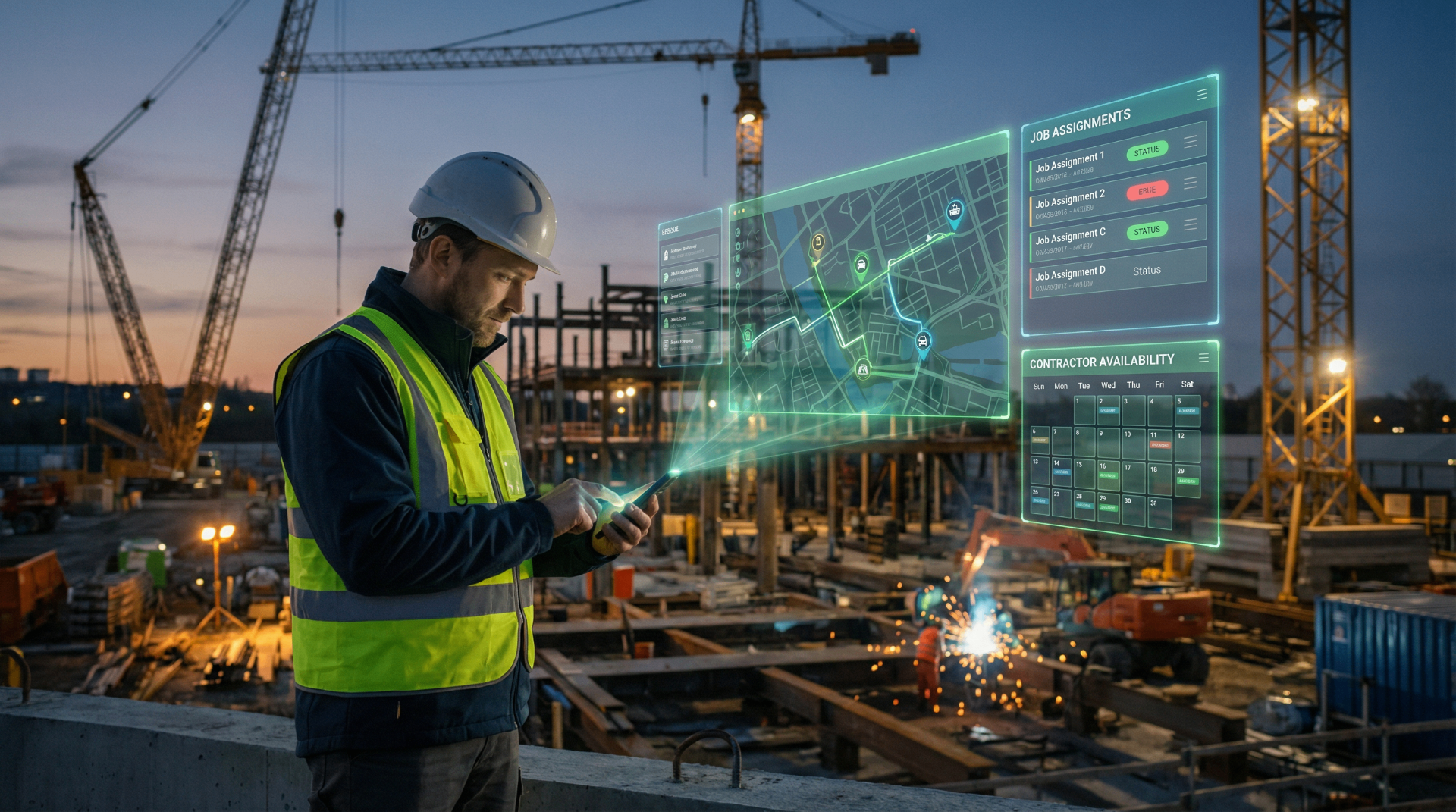
How AI is orchestrating the future of construction: productivity, safety, and coordination in a single view.
3. Technology Adoption Is a Human Feedback Loop
Journalistic accounts of digital transformation tend to focus on the software. The field reality is different. Robert Clark of the Universal Group in Vancouver saw digital form submissions jump from 18,000 to over 80,000 in a single year, a roughly 400% increase.
That did not happen because the app saved clicks. It happened because the technology triggered a human response. When field crews noted mechanical issues like failing wiper blades or brake lights on digital forms, the office actually read the notes and called them back to schedule repairs. Once workers realized the technology was a two-way channel that addressed their immediate needs, adoption skyrocketed.
The strategic takeaway: in the field, a tool is only as good as the response it triggers from the office. Clicks matter far less than the feeling of being heard.
4. The High Cost of the Information Problem
According to the Procore Future State of Construction report, the industry faces a massive Visibility Gap that drains productivity. 18% of project time is spent searching for data. 28% of total project time is spent on rework or rectifying issues.
That gap means owners often learn about ground-level reality only after it has already shifted. While many vendors market the myth of a 'Single Source of Truth,' a more practical goal for complex builds is 'Transparency for Everyone.' As consultant Manny Nomado suggests, truth is often viewed through different panes of glass. The objective is to integrate data across ERP and project management systems so financial and operational realities are visible to all stakeholders simultaneously, enabling pattern recognition before conditions deteriorate.
5. The Future Builder Is a Digital-Twin Orchestrator
The next generation of the workforce expects data to work 'like Google.' They will not tolerate siloed information or static binders. The role of the builder is shifting toward orchestrator of digital twins, a visual and spatial data layer that mirrors the physical site.
AI-driven tools like Highwire's AI Findings are turning spoken observations into structured data. The true value emerges when that data is mapped onto a visual twin of the project. As Matthew Daly of DroneDeploy notes, the future involves humans orchestrating robots and sensors to create a visual copy of the site, allowing 'a million eyeballs' to look for risks. This does not replace field experience. It multiplies it.
The most successful firms will be the ones that use this coordination infrastructure to empower their most experienced people to make better decisions, faster.
From Paperwork to Intelligence
The shift from managing individual hazards to system-level orchestration is no longer optional. The real exposure in a construction company isn't in the technology budget, it's in the coordination infrastructure that gives that data meaning.
Technology is a tool. Coordination is the job. To test your organization's current infrastructure, ask one question: without pulling last week's report, could your leadership team accurately describe the risk profile of every active zone on your jobsite right now?
What You Need to Know About AI in Construction, Today
Three free infographics distilling the orchestration playbook (trade stacking, PMIS/ERP integration, and the Truth-for-Everyone data model) into a single visual download.
Download the free infographicsReady to take on more premium projects without adding to your overhead?
Lock in your flat-rate, unlimited-user fee with ServiceIQ today.
Start your free trialFrequently asked questions
Keep reading
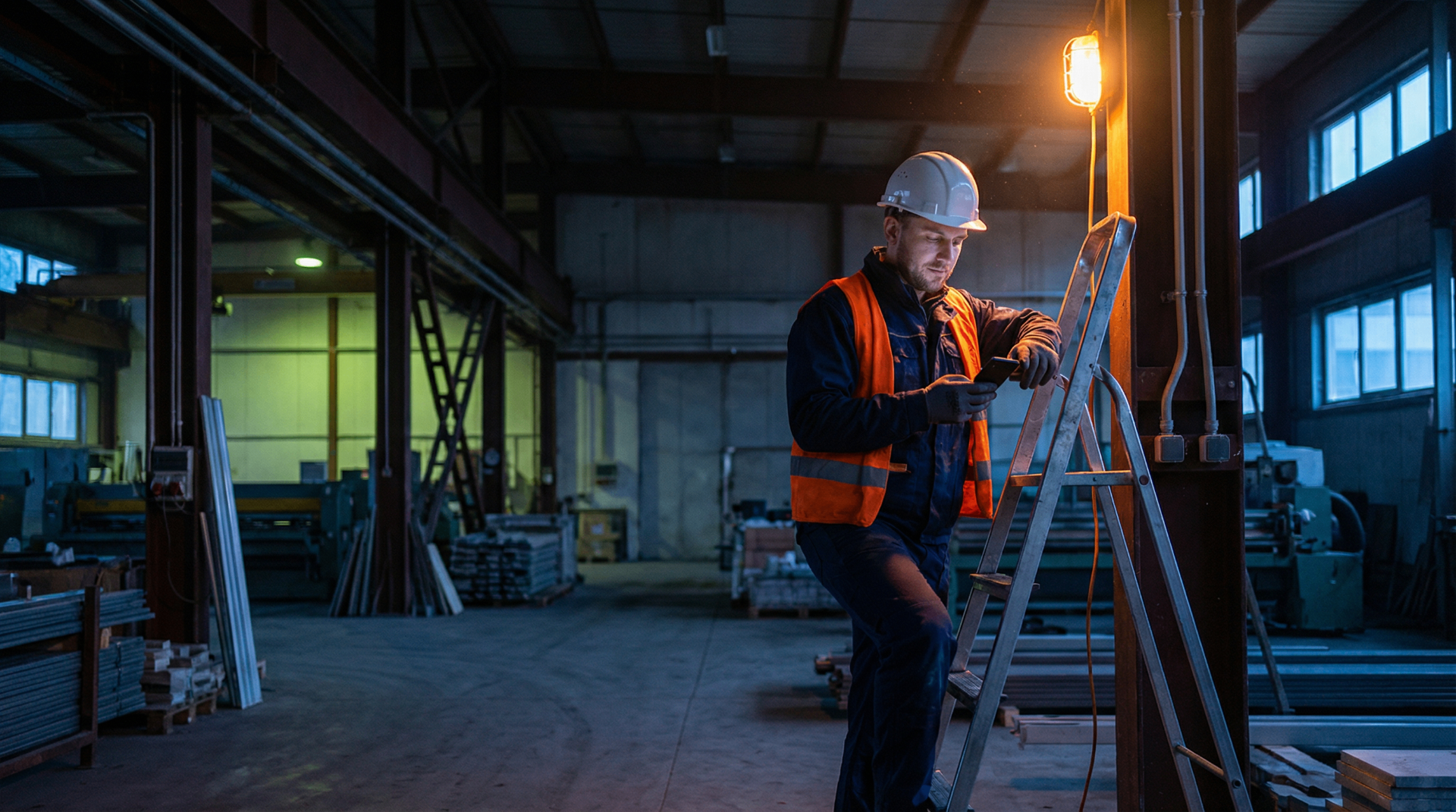
The Digital Hard Hat
A field-level primer on AI, robotics, and orchestration in modern construction: trade stacking risk, the Three Ds framework, layout robots, remote cranes, AI-powered safety, and the shift from legible paperwork to operational intelligence.
Unifying Construction Data
How hyperscale construction leaders close the visibility gap, moving from stored paperwork to system-wide orchestration through integrated PMIS/ERP data, digitized field intelligence, and a Truth-for-Everyone model.

What Is ServiceIQ?
ServiceIQ is a governed field service platform that helps HVAC and plumbing companies dispatch faster, cut callbacks, and turn every job into an auditable record.
Ready to take on more premium projects without adding to your overhead?
Lock in your flat-rate, unlimited-user fee with ServiceIQ today.
Start your free trial