
The Digital Hard Hat: A Primer on AI and Robotics in Modern Construction
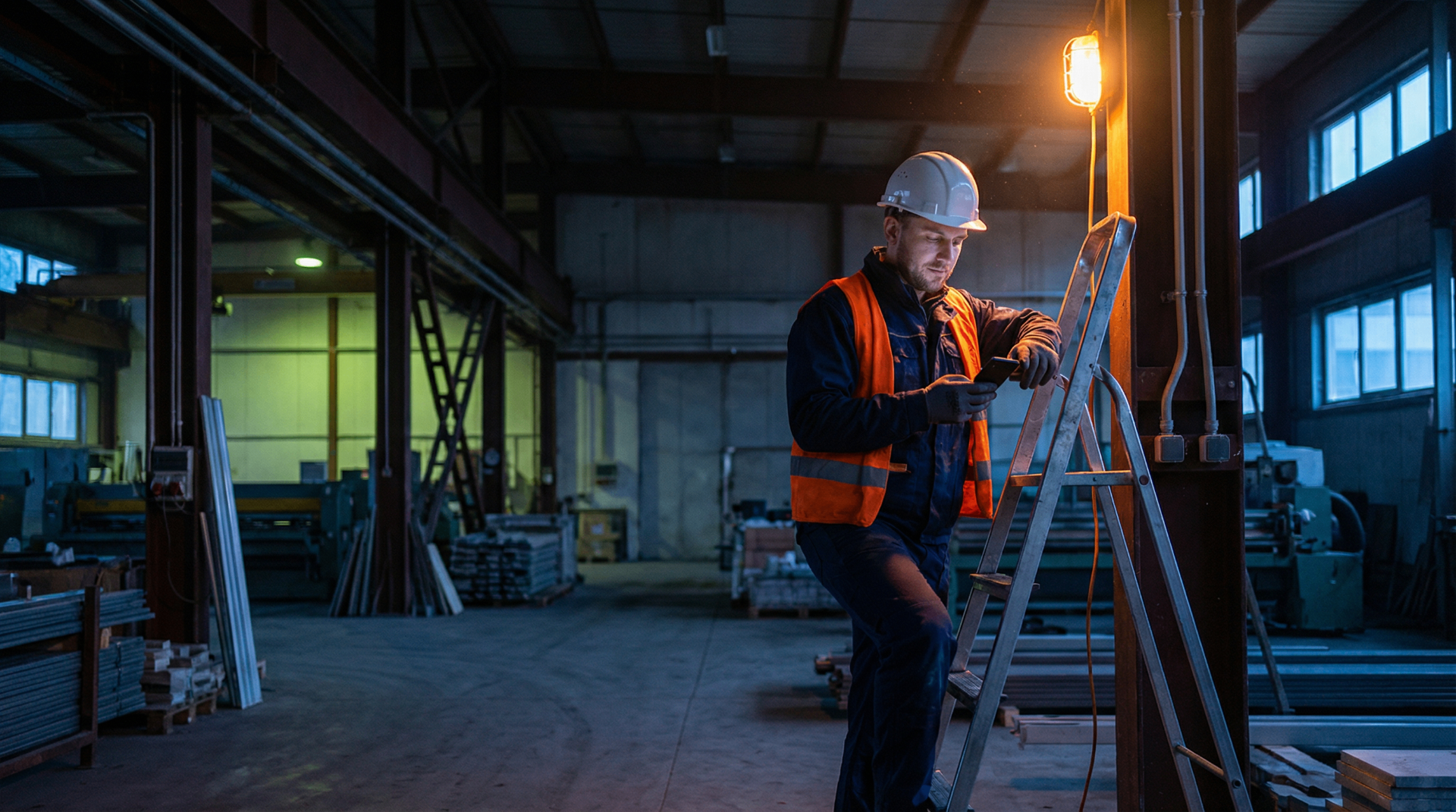
Quick answer: A modern construction jobsite is a living organism: volatile, uncertain, constantly changing, and ambiguous. The 'digital hard hat' is the operating discipline that makes it manageable: delegate the Dull, Dirty, and Dangerous to robots; turn every field observation into structured, pattern-matched data with AI; and orchestrate 40+ trades against one shared reality so trade stacking stops silently burning $14M-per-month delay penalties and $15–25M arc flash exposures.
Key Takeaways
- ●Construction is inherently VUCA (Volatile, Uncertain, Changing, Ambiguous) which is why one-size automation fails.
- ●The 'Three Ds' framework (Dull, Dirty, Dangerous) is the right filter for what to automate first.
- ●Layout robots run ~10x faster than manual chalk-and-tape layout and save workers from chronic knee and back strain.
- ●Remote-operated tower cranes (e.g. Winvic on Crown Place Birmingham) improved lifting efficiency by ~10%.
- ●A 'more legible but less informative' digital checkbox is not progress. AI must turn observations into structured findings.
- ●Trade stacking on hyperscale builds carries $15–25M arc flash exposure and up to 19% of total project cost in rework.
- ●The endgame is Orchestration: people + machines + data resolving to one live source of truth, with humans as the Validation Layer.
The High-Stakes World of Construction
Unlike a factory floor, where a machine repeats the same task on a static surface, a construction jobsite is a living organism. Every project moves the product, the personnel, and the environment itself. That is why construction remains one of the hardest industries to automate: every build carries unique site conditions, shifting designs, and a revolving door of specialized trades.
Industry leaders describe the jobsite with the VUCA framework: Volatile pricing and hourly site changes; Uncertain labor and weather; Changing designs that arrive mid-mobilization; and Ambiguous conditions hidden behind walls or under dirt that invite multiple interpretations of risk.
The 'Three Ds': Why We Automate
The primary motivation for introducing robotics is the 'Three Ds' framework. By delegating tasks that are Dull, Dirty, or Dangerous to machines, we free humans to focus on work that actually rewards judgment, intuition, and problem-solving.
- →Dull: repetitive brute work, carrying supplies, snapping chalk lines for weeks on end.
- →Dirty: heavy dust, debris, and exposure to hazardous waste materials.
- →Dangerous: working at extreme heights or carrying heavy loads across uneven terrain.
Automation Is Augmentation, Not Elimination
The point of automating the Three Ds is not to remove people. It is to remove drudgery and physical strain so workers can spend more of their day on coordination, quality control, and the parts of the job that require a human on-site making a judgment call.
Framed correctly, the digital hard hat is a wearable upgrade to the craft, not a replacement for it.
Layout Robotics: From Chalk Line to Digital Print
Traditional layout puts a worker on their hands and knees with a tape measure and a Sharpie. Layout robots (like those from Dusty Robotics) transform this into a high-precision, digital workflow.
- →Speed: robots can complete floor layouts roughly 10x faster than manual methods.
- →Health: automated marking eliminates the chronic knee and back strain that used to define the role.
- →Coordination: with the layout printed directly on the floor, superintendents can walk the site and see exactly how every MEP component will fit before installation begins.
Remote-Operated Tower Cranes: The Winvic Case Study
On the Crown Place Birmingham project, Winvic operated a remote robotic tower crane. Instead of climbing hundreds of feet into a cramped cabin, the operator sits in an immersive, ground-level suite of screens.
Usage data analyzed by the crane's own system suggested lift-sequencing optimizations that improved lifting efficiency by roughly 10%, a compounding gain across every lift for the rest of the build.
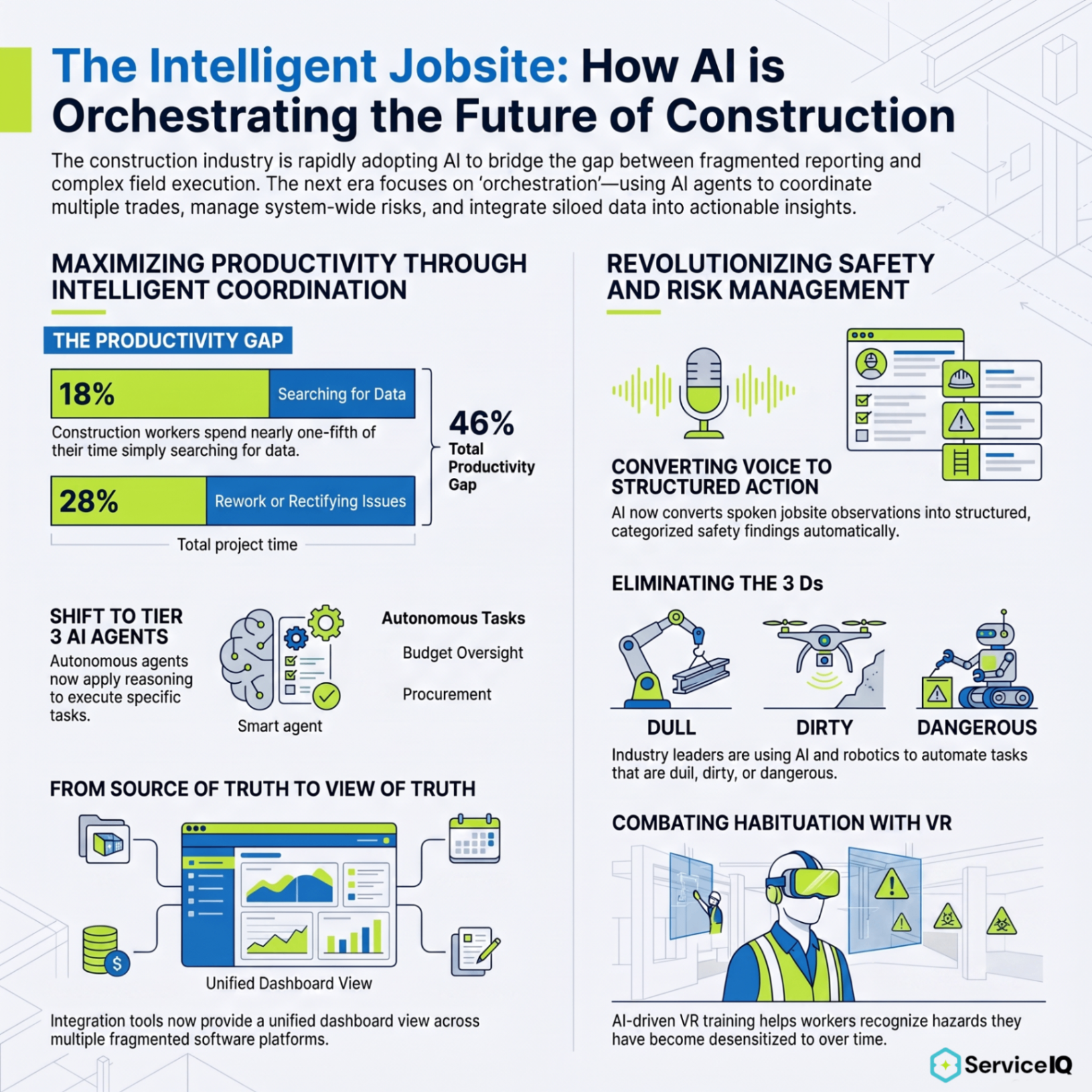
The Intelligent Jobsite at a Glance
How AI is orchestrating the future of construction: productivity, safety, and coordination in a single view.
AI-Powered Safety: Beyond the Digital Checkbox
Historically, safety documentation has been a reactive habit, paper forms that vanish into static binders. Simply moving those forms to a tablet does not solve the problem. As safety expert Cory Linton puts it, a digital checkbox lacking specific detail is often 'more legible but less informative.'
Modern AI tools turn observations into structured data through a repeatable voice-to-data workflow.
- →Dictation: a worker records a natural observation, 'Unprotected edge on level 4, north bay.'
- →AI Categorization: the system identifies the hazard type (e.g., Fall Protection).
- →Risk Assignment: the AI assigns a risk level based on the description and location.
- →Structured Finding: the spoken words become a trackable, searchable data point with a named owner for the fix.
Pattern Recognition Across Thousands of Field Reports
No human team has the bandwidth to read 5,000 field reports. AI can, and its real value is signal detection: identifying which specific zones, shifts, or subcontractors are absorbing disproportionate risk before an incident occurs.
That shifts safety leadership from 'walk the schedule' to 'walk the risk map', presence allocated to where the data says exposure is compounding, not where the calendar says to look next.
Managing Trade Stacking on Hyperscale Builds
On hyperscale projects (data centers, semiconductor plants, gigafactories) the greatest threat is Interaction Risk caused by Trade Stacking. Schedule pressure forces multiple crews (structural, mechanical, electrical) into the same tight corridor at the same time.
When coordination fails in stacked zones, the financial and safety stakes are catastrophic.
- →Catastrophic Safety Events: a major arc flash event can cost $15M to $25M in liability, fines, and equipment replacement.
- →Delayed Milestones: project delays on a 60MW facility can run $14M per month.
- →Systemic Rework: coordination failures produce out-of-sequence work that accounts for up to 19% of total project cost.
Orchestration: The Real Job
The ultimate goal of construction technology is Orchestration, linking people, machines, and data into a single source of truth where every stakeholder sees the same reality in real time.
The digital hard hat is not a device. It is the operating discipline that turns dictation, layout prints, crane telemetry, and inspection findings into one live picture the whole team can act on.
Upskilling for the New Era
As technology absorbs the physical-ability side of construction, the required skill set is shifting toward digital literacy, coordination, and judgment. Roughly 45% of workers want to develop technical skills as part of their career growth.
Remote and mobile technology also directly addresses the burnout crisis: 45% of workers cite burnout as a primary reason for leaving the industry. VR/AR walk-throughs and voice-to-data tools let quality checks happen from an office instead of a hotel room, and let field crews disconnect once the job is done.
The Orchestrator Role: Humans as the Validation Layer
As Amir Berman of Buildots explains, experienced professionals are the ones who 'walk next to a project and sense that something is off.' AI provides the data. Humans use that data to prove their hunches and make the final call.
On today's builds, getting coordination right is the job. Technology provides the infrastructure: the human remains the orchestrator. Success depends on having a clear operational picture, and the discipline to act on the data before site conditions deteriorate.
What You Need to Know About AI in Construction, Today
Three free infographics distilling the orchestration playbook (trade stacking, PMIS/ERP integration, and the Truth-for-Everyone data model) into a single visual download.
Download the free infographicsReady to take on more premium projects without adding to your overhead?
Lock in your flat-rate, unlimited-user fee with ServiceIQ today.
Start your free trialFrequently asked questions
Keep reading
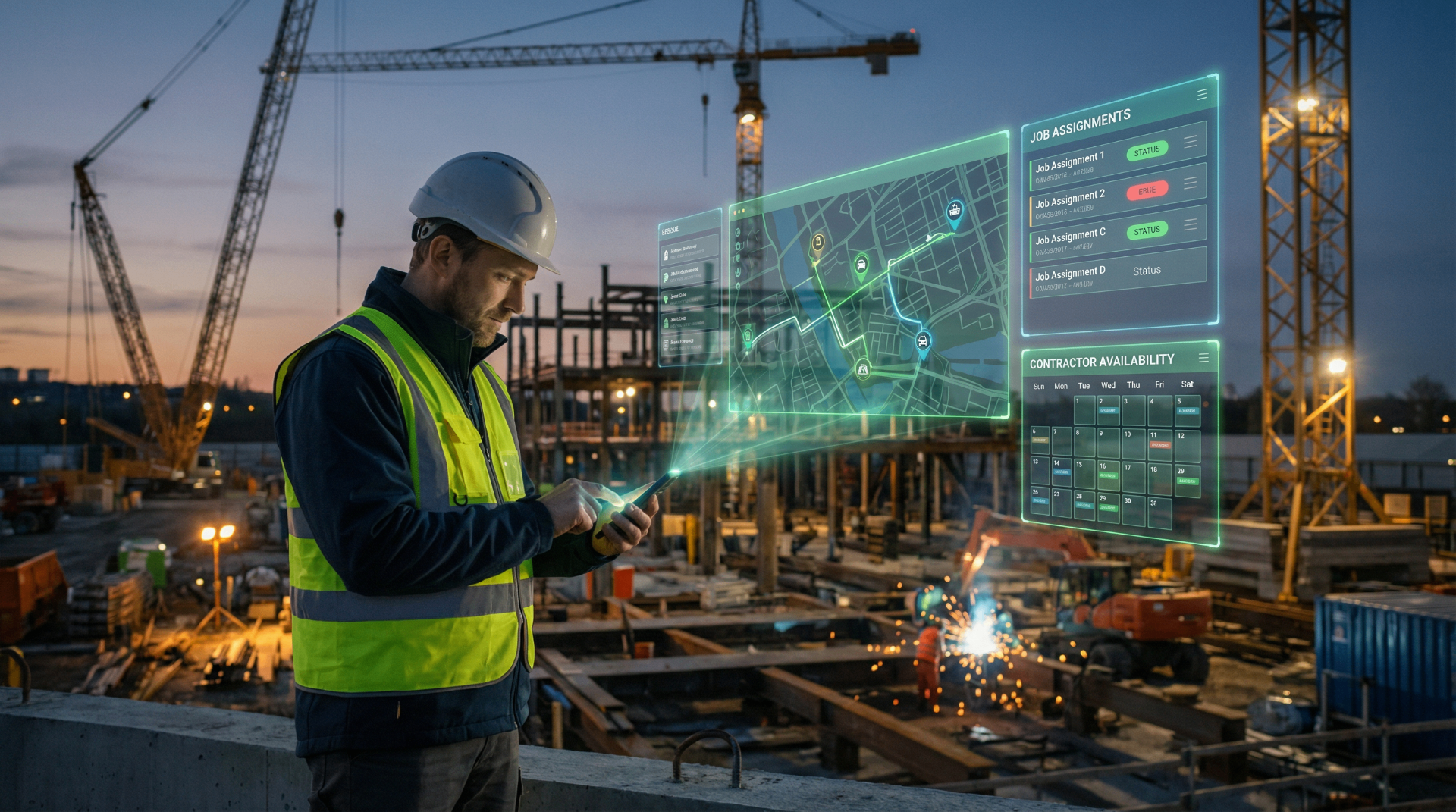
Unifying Construction Data
How hyperscale construction leaders close the visibility gap, moving from stored paperwork to system-wide orchestration through integrated PMIS/ERP data, digitized field intelligence, and a Truth-for-Everyone model.
The Misplaced Mission
You didn't get into contracting to debug software. Here's how DIY app-building quietly turns a construction CEO into an unpaid product manager, and what to do about it.

What Is ServiceIQ?
ServiceIQ is a governed field service platform that helps HVAC and plumbing companies dispatch faster, cut callbacks, and turn every job into an auditable record.
Ready to take on more premium projects without adding to your overhead?
Lock in your flat-rate, unlimited-user fee with ServiceIQ today.
Start your free trial