
Site Operational Framework: Orchestrating the AI-Augmented Jobsite
Modern jobsites are living organisms: volatile, uncertain, changing, ambiguous. Orchestration is the layer that turns AI adoption into system-wide risk reduction, not just optimized tasks.
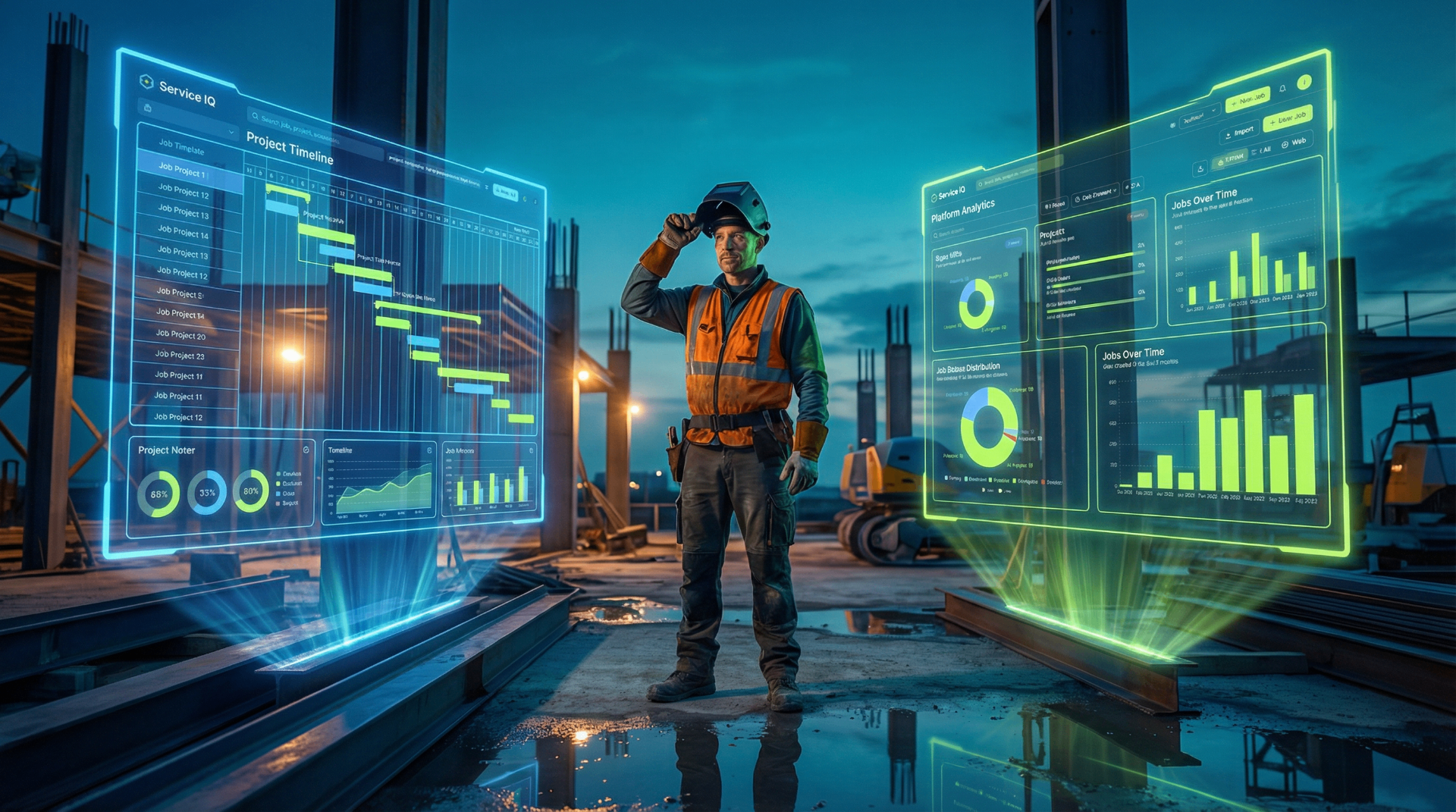
The Jobsite as a Living System
Modern construction projects are best understood as complex "organisms" that are inherently alive and dynamic. Unlike a traditional factory where products move through a fixed assembly line, construction involves moving the "factory" to a new site for every project, often contending with unpredictable site conditions and shifting product specifications. This transition from sequential builds to compressed, hyperscale projects necessitates a new operational philosophy.
Success depends on the ability to manage a living system where the industry has moved from being perceived as "tech laggards" to a phase of "accelerated adoption," yet the gap between digital tools and field-level coordination remains wide.
The current environment is defined by the VUCA model, which categorizes the specific pressures facing today's jobsites:
- Volatile: Rapidly fluctuating pricing and the constant, high-speed movement of diverse crews across a single site.
- Uncertain: Unpredictability driven by shifting weather patterns and chronic labor shortages.
- Changing: Continuous design iterations and evolving "site conditions" that require immediate, real-time pivots.
- Ambiguous: Complex project requirements where the path forward is obscured by overlapping trade responsibilities.
Despite the rapid influx of technology, a significant "Visibility Gap" persists. While contractors are adopting AI to improve safety and reporting, these tools are often layered onto fragmented coordination infrastructures.
When AI adoption moves faster than the systems meant to support it, the technology optimizes discrete tasks rather than reducing system-wide risk. This creates a landscape of "interaction risks" that traditional safety models, focused on individual hazards, are simply unequipped to handle.
Deconstructing the "Coordination Problem" and Interaction Risk
On hyperscale builds, the primary threat to safety and enterprise value is Interaction Risk. As projects move from sequential to simultaneous workflows, risk becomes embedded in how the entire site is sequenced. Safety management must evolve from managing individual hazards to conducting an "orchestra" of intersecting trades.
The most dangerous manifestation of this problem is Trade Stacking. In the drive to meet compressed timelines for data centers or semiconductor plants, independent crews are forced to occupy the same corridors and zones simultaneously. When structural, mechanical, and electrical teams are stacked in a single corridor without full alignment, the pressure compounds into system failure.
The financial stakes of these failures are staggering. High-impact, low-frequency events carry costs that can threaten project viability:
Total cost per incident including injury liability, equipment replacement, and litigation.
Delay costs for a 60MW facility, a monthly bleed that compounds across every stacked trade.
The Orchestration Layer: Integrating AI into Field Infrastructure
Orchestration is the missing link between AI deployment and effective execution. It represents a strategic shift from optimizing discrete workflows to managing a unified system of people and machines.
Digitizing the Pre-Task Plan (PTP)
To convert PTPs from static documentation into operational intelligence, field leaders must follow a rigorous digitization protocol:
- Digitize Submissions: Shift all PTPs to digital platforms to enable real-time visibility for all stakeholders.
- Evaluate Quality: Use AI to flag vague or weak hazard recognition entries (e.g., "fall hazards" without specifying edge protection).
- Identify Overlap: Cross-reference PTPs across different trades to detect trade stacking before crews mobilize.
- Surface Control Gaps: Use pattern recognition to identify recurring gaps across specific crews or zones.
AI-Driven Safety and Worker Health
Professional tools like Highwire's "AI Findings for Inspections" convert spoken observations into structured data via speech-to-text dictation. This improves documentation quality and allows safety leaders to prioritize their time in high-risk zones. This is further augmented by wearable technology, such as Studson helmets equipped for monitoring live worker health, which can alert management to real-time heat stress, ensuring workers take required breaks before an incident occurs.
Robotics as Coordination Catalysts
Robotics act as catalysts for better coordination by addressing the "3 Ds": tasks that are Dull, Dirty, or Dangerous. Autonomous layout tools, such as Dusty Robotics, empower forepersons to focus on high-level coordination rather than brute work. By automating layouts for MEP, dry lining, and joinery, these tools complete the process 10x faster than traditional methods and significantly reduce RFIs and rework by ensuring trades do not clash.
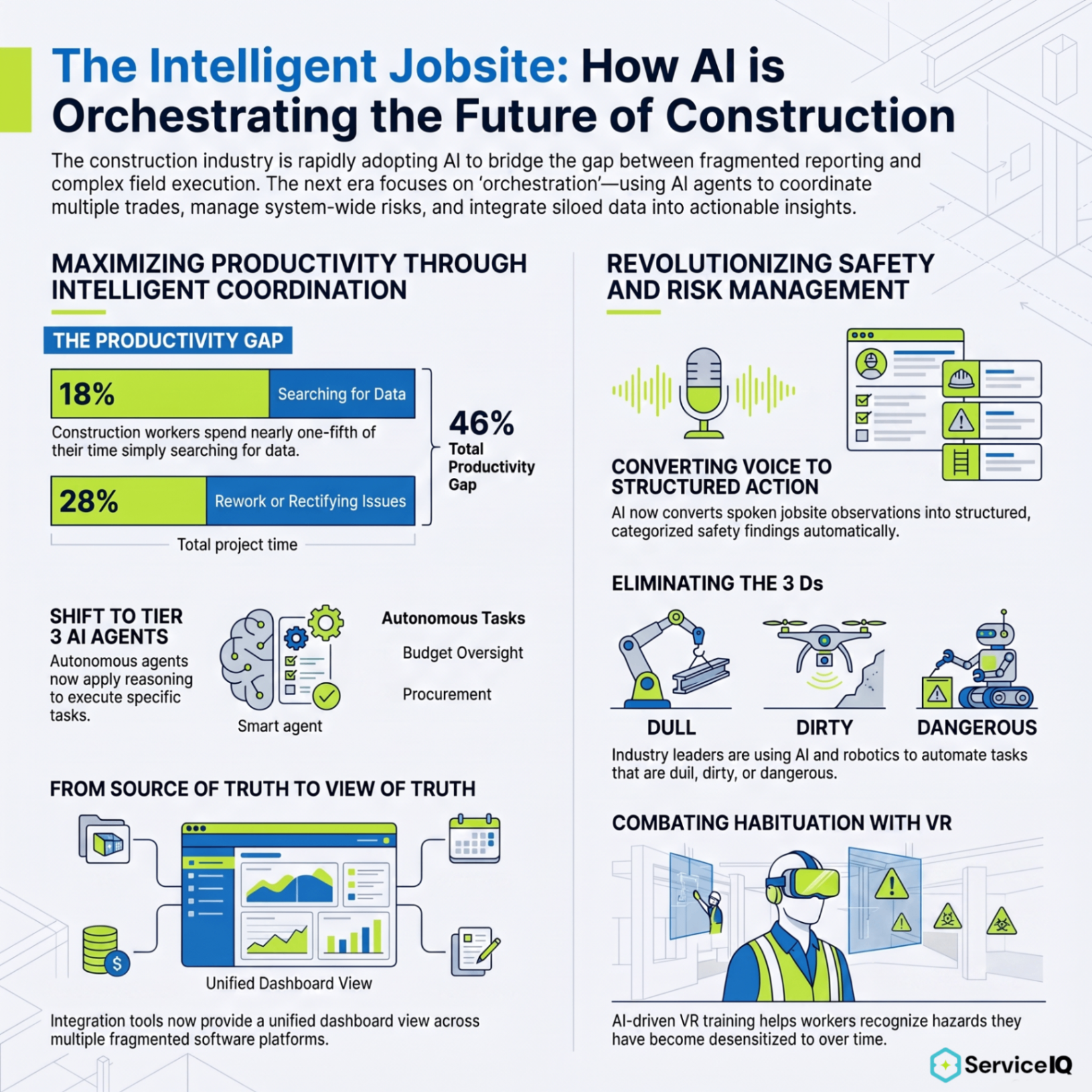
The Intelligent Jobsite at a Glance
How AI is orchestrating the future of construction: productivity, safety, and coordination in a single view.
Data Integration: Establishing the "Single Source of Truth"
While the litigious nature of the industry often leads stakeholders to keep an "ace in the hole," a Project Management Information System (PMIS) like Kahua provides the foundation for arguing over a single set of facts.
| Fragmented Reporting | Integrated Orchestration |
|---|---|
| Lagging monthly incident and cost summaries. | Real-time updates and daily visibility into site conditions. |
| Siloed subcontractor processes and hidden data. | Shared operational picture and transparent cost-to-complete. |
| Monthly "Whip Reports" and budget reviews. | Daily cost-to-complete tracking and transaction updates. |
| Static binders and trailer-based documentation. | Natural language "Chatbot" interfaces for ad-hoc reporting. |
AI's greatest value within this ecosystem is predictive pattern recognition. By processing thousands of inputs (PTPs, field observations, and subcontractor participation rates) it surfaces signals that no human team has the bandwidth to manually identify. The next evolution of this integration is the use of natural language interfaces, allowing leaders to ask specific, ad-hoc questions of their data to inform day-to-day decision-making before conditions on the ground deteriorate.
Accountability and Operational Diagnostics
As the workforce shifts toward roles requiring skills in programming and project management, individual and collective accountability must remain the priority.
The Ownership Mandate
To close the loop on risk, every corrective action must have a named owner. Assigning tasks to "departments" or "roles" is explicitly forbidden. Individual accountability is the only mechanism that ensures identified hazards are mitigated and findings result in actual fixes.
Operational Diagnostic Checklist
Site leaders must use the following diagnostic to evaluate site readiness and resilience:
- Are PTPs being reviewed for hazard recognition quality, or just collected for compliance?
- Can the leadership team describe the risk profile of every active zone right now?
- Are all corrective actions assigned to a specific named individual with a firm deadline?
- Is field data being used to identify which subcontractors or zones are absorbing disproportionate risk?
- Are all stakeholders arguing over a single set of facts, or does every party have their own version of the "truth"?
The Resilience Dividend
A technology-driven coordination framework has a profound influence on company resilience. Statistics show that 65% of construction professionals believe technology adoption highly influences their company's resilience to risk. By automating the "3 Ds," firms not only improve safety but also create a more fulfilling workplace that attracts the next generation of technical talent.
In the age of AI and hyperscale builds, getting coordination right is the job: everything else depends on it.
What You Need to Know About AI in Construction, Today
Three free infographics distilling the orchestration playbook (trade stacking, PMIS/ERP integration, and the Truth-for-Everyone data model) into a single visual download.
Get 3 Infographics on AI in Construction for FREE nowRelated Reading
Explore more from the Field Service Knowledge Base.
AI Field Service Management
How AI is transforming dispatch, work orders, and field ops.
Learn moreData Center Construction Boom
The $77.7B surge and what mid-market GCs need to know.
Learn moreConstruction Document Management
The seven document categories every commercial project runs on.
Learn moreAudit-Ready by Default
Every job an exportable, defensible record from day one.
Learn moreRun your jobsite on one governed platform
ServiceIQ gives GCs and multi-trade operators a single source of truth: from PTPs to punch-out.