
The Data Center Construction Boom: A Gold Rush or a Minefield for GCs?
Record demand collides with grid gridlock and local opposition. In 2026, the biggest GC risk isn't cancellation: it's a delay long enough to make your entire bid obsolete.
The Most Aggressive Infrastructure Surge in Modern History
Nvidia projects that agentic AI will demand 1,000% more compute over the next two years, forcing hyperscalers to pour a torrent of capital into concrete and steel. By December 2025, the average data center cost had exploded 70% in a single year to $633 million.
For a commercial General Contractor, the financial temptation to chase these megaprojects is undeniable. But this unprecedented boom is colliding with a brutal regulatory and utility reality.
In the first quarter of 2026 alone, 75 major data center projects worth $130 billion hit immediate delays or outright blocks due to local opposition and power grid gridlock. In this environment, the greatest risk isn't cancellation: it's that these projects get paused just long enough that your pricing, long-lead procurement assumptions, and labor schedules become completely obsolete, forcing you to act as the involuntary insurer of the owner's risk.
The Financial Scale of the "Gold Rush"
The financial trajectory of data center construction is vertical. The momentum is best illustrated by the "Fourth-Quarter Surge" of 2025, where construction starts totaled $44.4 billion, a figure that exceeded the total starts for the entire year of 2024 by 160%.
| Metric | 2024 | 2025 |
|---|---|---|
| Total Construction Starts | $17.1 Billion | $77.7 Billion |
| Year-over-Year Increase (Starts) | 80% | 190% |
| Average Cost Per Square Foot | ~$530 | $1,033 |
This explosion in spending is accompanied by massive cost-per-project inflation. "In December, the average data center cost $633 million in 2025, up 70% over the prior year's average.": Michael Guckes, ConstructConnect, February 3, 2026.
Furthermore, the demand has created a critical secondary market: power infrastructure. Spending in this sector is forecasted to reach $27.8 billion in 2026, representing a necessary 70% rebound to keep data centers energized.
The Interconnection Bottleneck: Speed to Power
In this environment, "Speed to Market" has been superseded by "Speed to Power." Interconnection flexibility is now the primary metric for project success. Hyperscalers are increasingly willing to negotiate "load flexibility", the ability to modulate energy demand, in exchange for faster grid connections.
The Electric Power Research Institute (EPRI) defines five "Flexibility Classes" (A through E). For GCs, these classes represent specific hardware and operational requirements that must be integrated into the bid:
Class A / B: Daily & Extreme Peaks
Requires integration of high-capacity battery storage or onsite backup power to modulate through daily peaks and extreme events.
Class C: Long-Term Shortage
Involves sophisticated demand-side management protocols coordinated with the utility across multi-hour and multi-day events.
Class D / E: Sudden Swings & Frequency
GCs must source higher-grade frequency stabilization hardware and rapid-response switching gear engineered for sub-second grid events.
The Three Pillars of Flexibility
Managed workloads (pausing non-critical AI tasks), reduced plant energy consumption (optimized cooling), and backup power (onsite generation during grid stress).
"Hyperscalers want their data centers online and utilities want to provide interconnections, but experts say both are still looking for common operating guidelines."
: Herman K. Trabish, Construction Dive, June 29, 2026
The Rise of Local Opposition
The most significant threat to the $88 billion preconstruction pipeline is community and regulatory pushback. In Q1 2026 alone, Data Center Watch reported 75 projects worth $130 billion hit delays or blocks: a volume nearly matching all of 2025.
Home Rule Power
Cities like San Marcos, Texas are utilizing "Home Rule" authority to exert expanded zoning power. San Marcos recently became the first Texas city to outright ban data centers.
"San Marcos has become the first Texas city to ban data centers within city limits, banking on its local authority to stop the data center boom and setting a precedent for other municipalities to follow.": Katlyn Ma, The Texas Tribune, June 30, 2026
County Limitations
Conversely, counties often lack legally binding zoning authority. Hill County was forced to rescind a moratorium after a $100 million lawsuit.
GCs must recognize that county-level blocks are often legally fragile, whereas city-level zoning changes are far more difficult to overturn.
Prescriptive Contractual Safeguards
To avoid becoming the "insurer of the risk," GCs must adopt the documentation rigor suggested by legal experts Mark Carter (Buchalter), Viktor Pregel (Greenstein DeLorme & Luchs), and Tom Curran (Duane Morris).
The GC Contractual Checklist
- Force Majeure Expansion. Explicitly include local protests, community-led injunctions, citizen-initiated zoning lawsuits, and municipal construction moratoriums (Pregel).
- Escalation and Lead Times. Include specific escalation provisions for electrical equipment and address long-lead procurement risks up front (Carter).
- Suspension and Re-sequencing Rights. Ensure the contract allows for owner-directed re-sequencing and defines overhead recovery during suspensions (Carter).
- Approval Transparency. Require the owner to provide documented proof of utility commitments and environmental review status before groundbreaking (Pregel).
- Reimbursable Operational Costs during Pause (Curran):
- Crane and trailer rentals
- Site security and maintenance
- Demobilization and remobilization
- Key personnel retention fees
"The biggest contractor risk isn't necessarily the project gets canceled. It's that the project gets delayed long enough that all the assumptions underlying the contractor's price and schedule become obsolete."
: Sebastian Obando, quoting Mark Carter, Construction Dive, June 30, 2026
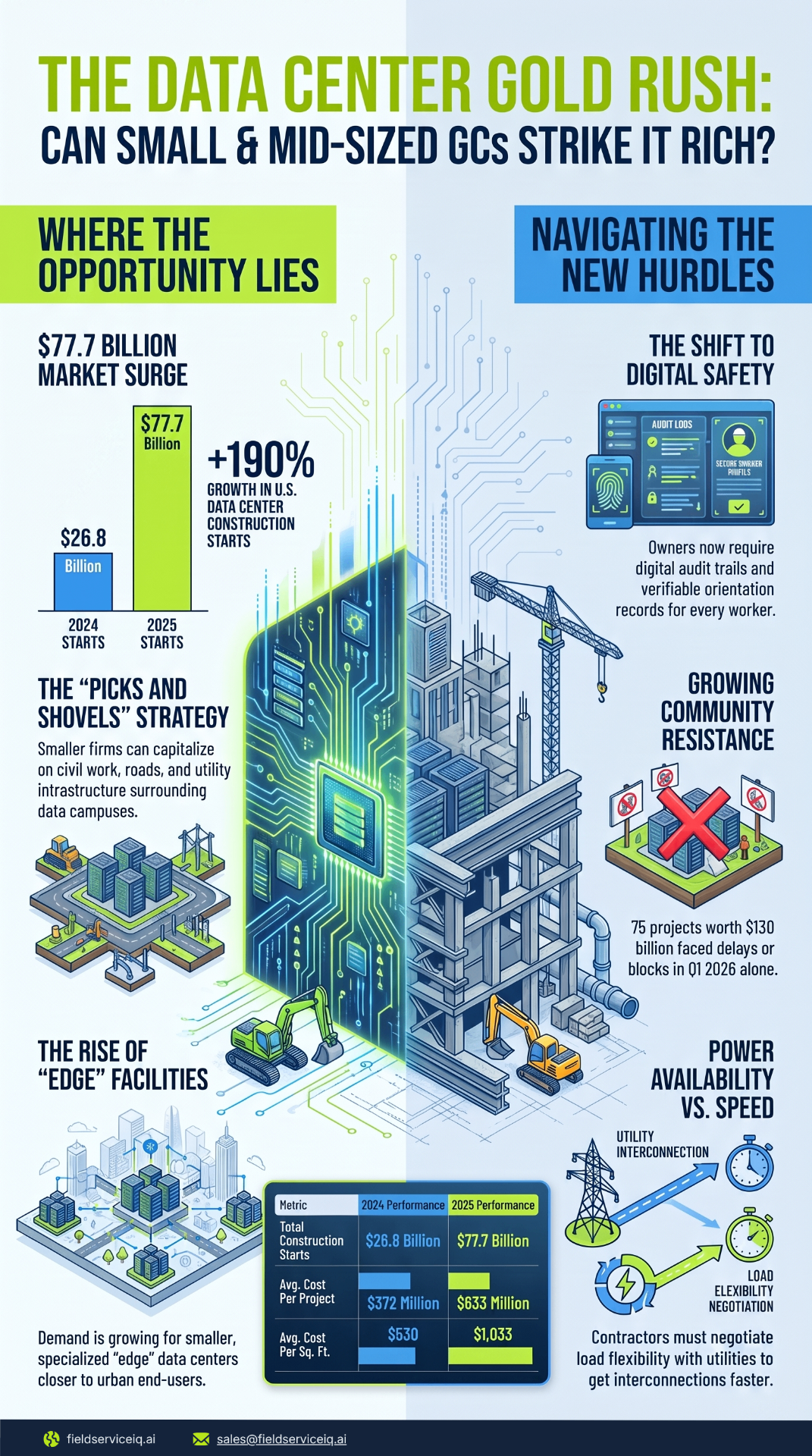
Get the Free "Data Centers: A Gold Mine for GCs?" Infographics
Five shareable visuals covering the $77.7B market surge, the picks-and-shovels play, edge facilities, digital safety & community hurdles, and power vs. speed: sent straight to your inbox.
Download the FREE InfographicsThe 80% Paradox for the Mid-Sized GC
The data center sector presents a paradox: record-shattering demand vs. intensifying regulatory and utility constraints. This is a viable gold rush only for firms that accept a fundamental "Shift in Quality of Service" expectations.
As framed by Schneider Electric, the new reality of "Speed to Power" means GCs must prepare owners for the 80% Paradox: the choice between "having 80% of the data center working or none of it." Success belongs to firms that prioritize schedule resilience over raw speed.
"The projects that are going to perform best will be the ones where the parties identify the risks early and clearly decide who is responsible for them before construction starts."
: Sebastian Obando, Construction Dive, June 30, 2026
Sources and Further Reading
- ConstructConnect. Michael Guckes: 2025 data center cost inflation and December quarterly surge analysis (Feb 3, 2026).
- Construction Dive. Herman K. Trabish on hyperscaler–utility operating guidelines (June 29, 2026) and Sebastian Obando on contractual risk allocation (June 30, 2026).
- The Texas Tribune. Katlyn Ma on San Marcos, Home Rule authority, and the first Texas municipal data center ban (June 30, 2026).
- Data Center Watch. Q1 2026 project delay and block tracker: 75 projects, $130B in exposure.
- Electric Power Research Institute (EPRI). Load Flexibility Classes A–E: hardware and operational implications for interconnection.
- Schneider Electric. The 80% Paradox framing for phased data center commissioning under grid constraint.
- Legal commentary. Mark Carter (Buchalter), Viktor Pregel (Greenstein DeLorme & Luchs), Tom Curran (Duane Morris); force majeure, suspension, and pause-cost reimbursement provisions.
Related Deep Dives
Continue exploring how mid-market GCs govern risk on large commercial programs.
Govern the Megaproject. Don't Insure the Owner's Risk.
ServiceIQ gives commercial GCs the audit-ready record, RFI/submittal governance, and change-log discipline that survive multi-year data center schedules.