
What AI Actually Belongs Near Your Construction Schedule (and What Doesn't)

Quick answer: AI genuinely helps with constraint-solving scheduling problems, predicting how long a task actually takes based on your own crews' history, flagging a task trending late before it's officially behind, and proposing the next-best assignment across multiple crews and constraints at once. It's a poor fit for judgment calls that involve a client relationship or reputational risk the software has no visibility into, which should stay recommendations a person approves rather than actions the system auto-commits. A lot of what gets marketed as AI scheduling is actually a conditional rules engine with a new name, and the way to tell the difference in a demo is to change one constraint live and watch whether the whole board re-solves or just one row updates.
Key Takeaways
- ●AI is a genuinely good fit for constraint-solving problems: predicting task duration from your own history, flagging a task trending late, and proposing assignments across multiple crews at once.
- ●A lot of software marketed as "AI scheduling" is really a conditional rules engine with a new name, and it's worth asking a vendor to describe how a recommendation was actually generated.
- ●Client-facing judgment calls and anything with reputational risk the software can't see should stay a recommendation a person approves, not an action the system auto-commits.
- ●The fastest way to tell the difference in a demo: change one constraint live and see whether the whole board re-solves or just one row updates.
- ●Ask whether the system explains why it's recommending something, and whether an override gets remembered rather than just ignored once.
AI got attached to nearly every construction software pitch this year, some of it earned, some of it not. Scheduling is one of the places where the distinction actually matters, because a bad scheduling decision costs real money and real trust, fast, and it's worth knowing which parts of the job are genuinely a good fit for it before you turn anything loose on a live schedule.
Where AI Is Actually Good at This
Constraint-solving, weighing multiple crews, skills, locations, and deadlines against each other to find the assignment with the lowest total disruption, is a genuinely hard optimization problem, and it's exactly the kind of thing this class of tool is built for. Predicting how long a task actually takes based on your own crews' history, rather than a generic estimate, is the same category of problem. So is flagging a task that's quietly trending behind before it's officially late enough for a human to notice.
Where It's Still Just a Rules Engine With Marketing
A lot of what gets called AI scheduling is conditional logic dressed up with the label: if a task is unassigned and a crew is free, suggest the crew. That's not nothing, but it's not the same thing as a system weighing dozens of constraints against each other, and it's worth asking a vendor directly how a specific recommendation was actually generated rather than accepting the word AI as an explanation on its own.
The Decision That Should Stay With a Person
Anything involving a client relationship the software has no visibility into, or a judgment call with real reputational risk attached, shouldn't get auto-executed no matter how good the underlying model is. The useful version of this is a system that recommends and explains, and a person who approves, not a system that quietly acts and reports back after the fact.
How to Tell the Difference in a Demo
Ask the vendor to change one constraint live, pull a crew off the board, add a same-day emergency call, and watch what happens. A real constraint solver re-evaluates the whole board and proposes a new set of assignments. A rules engine updates the one row that was directly affected and leaves everything else exactly where it was.
Questions Worth Asking
- →Does it explain why it's recommending something, or just present a result?
- →Can you override a recommendation and have that preference remembered, not just ignored once?
- →Does changing one constraint re-solve the whole board, or just flag a single conflict?
- →Is the model trained on real outcome data, or is it a rules engine with a new name?
None of this is an argument against AI in scheduling. It's an argument for knowing which category of problem you're actually looking at before you decide how much to trust it.
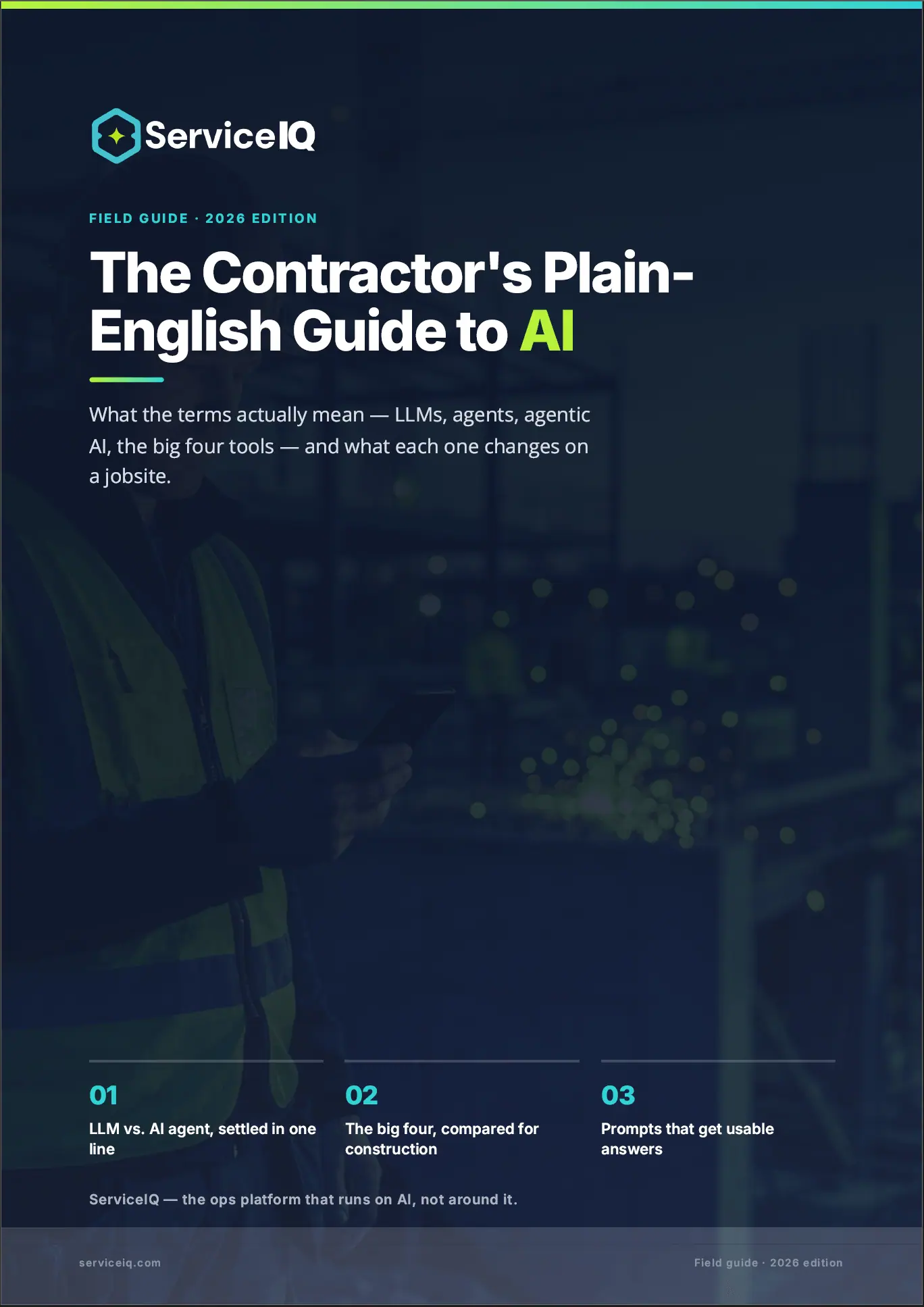
AI Questions You're Too Busy Running a Business to Ask
The plain-English breakdown of what actually separates a real AI agent from a rules engine with a new name.
Get the free eBookReady to take on more premium projects without adding to your overhead?
Lock in your flat-rate, unlimited-user fee with ServiceIQ today.
Start your free trialFrequently asked questions
Keep reading
AGC Tech 2026 Recap
Notes from the AGC Technology Conference, August 4–6 in Minneapolis: AI bootcamps, a back-office agent named Wendy, and why construction has stopped asking whether to use AI and started asking how.
You Can't Ban Your Way Out of Shadow AI
A dispatch from AGC Tech 2026, where every IT Director in the room had the same idea for stopping unapproved AI use, and the data says it's the wrong one.

Scaling Past 25 Technicians
Manual dispatch breaks at ~25 technicians. AI scheduling absorbs 60–70% of dispatcher decisions and lifts the dispatcher-to-tech ratio from 1:8 to 1:25. See the math, the mechanics, and the ServiceIQ implementation.
Ready to take on more premium projects without adding to your overhead?
Lock in your flat-rate, unlimited-user fee with ServiceIQ today.
Start your free trial