
CPM vs. Lean Scheduling: Should One of Them Just Retire?

Quick answer: Lean scheduling and CPM aren't really competitors. CPM calculates a project's critical path from a full dependency network, while Lean's Last Planner System has the trades pull plan their own weekly commitments. Most experienced practitioners run both together: CPM sets the owner facing master schedule and catches long lead time material orders, while pull planning handles trade level coordination inside it.
Key Takeaways
- ●CPM doesn't natively account for resource constraints, like two crews needing the same equipment on the same day, so a logically perfect schedule can still fall apart on site.
- ●Pull planning fixes construction's biggest cultural problem: a schedule built in an office and handed to the trades as gospel, with nobody who signed up to hit those dates.
- ●Pull planning sessions typically only look four to eight weeks ahead, which misses long lead time material orders that need to be placed months in advance.
- ●One early adopter, DPR Construction, found pull planning didn't change whether projects finished on time, but it did change how the trades worked together on the way there.
- ●Some Lean practitioners want a third method, Takt planning, to replace CPM as the master schedule, while still running Last Planner principles underneath it.
Quick Refresher, in Case It's Been a While
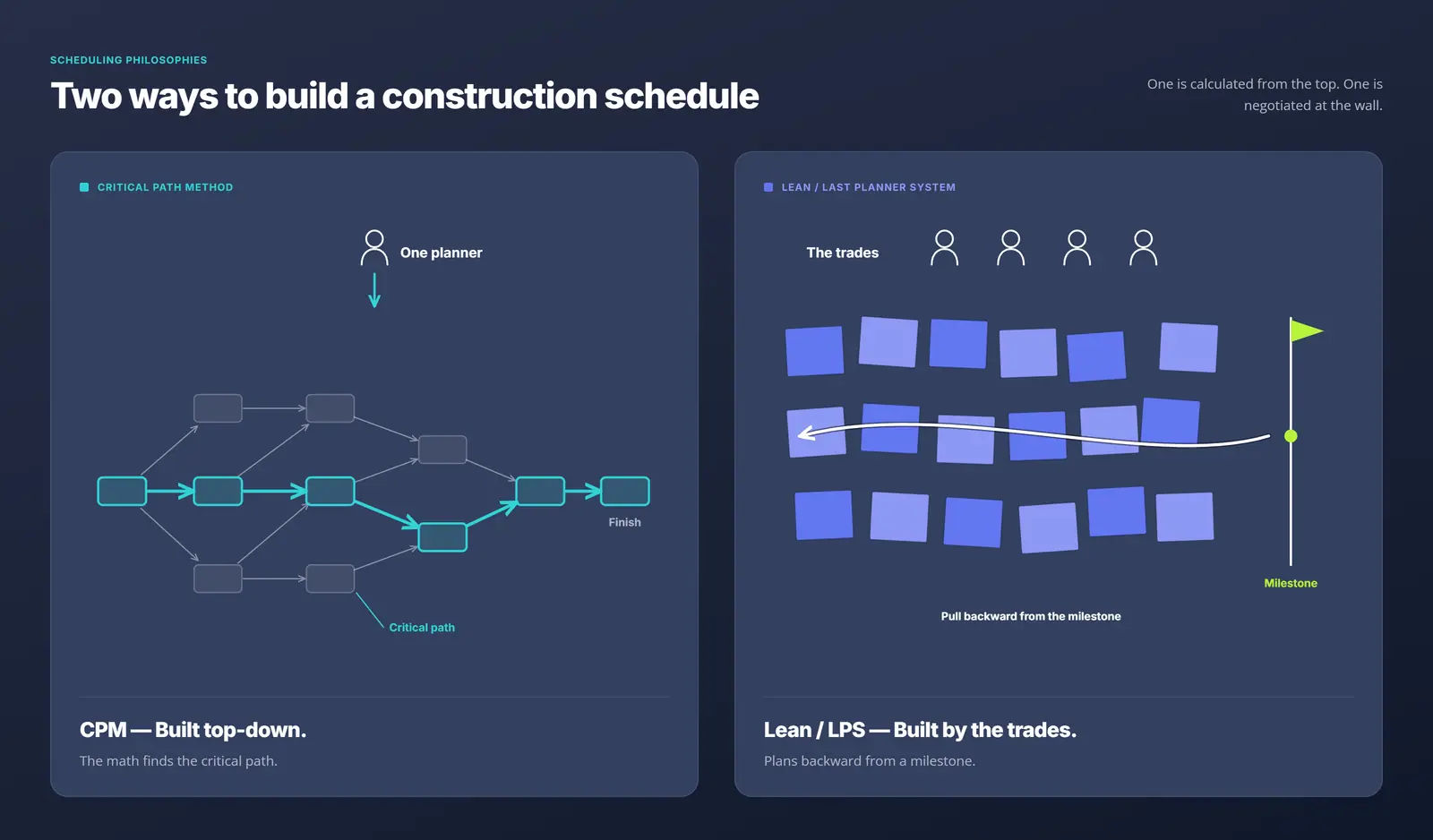
CPM (Critical Path Method) is the classic approach: build a network of every activity, figure out how they depend on each other, and calculate the "critical path", the sequence of tasks that, if any of them slip, pushes back the entire project. It's math driven, it's precise, and it's been the backbone of construction scheduling for decades.
Lean construction, and specifically the Last Planner System (LPS), flips that script. Instead of a scheduler building the plan top down and handing it to the trades, the people actually doing the work get in a room, usually with a wall full of sticky notes, and plan backward from a milestone. It's called "pull planning" because downstream work pulls from upstream work, instead of a schedule getting pushed onto people who didn't have a say in it.
Two very different philosophies. One says "the math will tell us the truth." The other says "the people doing the work know the truth better than the math does." Neither is obviously wrong.
The Case for "Lean Should Replace CPM"
This side doesn't get talked about as charitably as it deserves, so let's actually make the case properly.
CPM has a real, well-documented weakness: it's only as good as the estimates that go into it, and it doesn't natively account for resource constraints, two crews needing the same equipment on the same day, for instance. A perfectly logical CPM network can still fall apart on a real jobsite because the math didn't know your framing crew was double-booked.
There's also a cultural argument, and it's a sharp one. Too often, a CPM schedule gets built in an office, by someone who's never swung a hammer on this particular project, and then gets handed to the trades as gospel. If the schedule's wrong, the trades get blamed for missing dates they never actually agreed to hit. Pull planning fixes this by design; the schedule literally cannot exist without the trades in the room building it themselves.
And for certain kinds of work, especially fast moving interior fit outs or highly repetitive phases, a full CPM analysis can be genuine overkill. One construction scheduling writeup put it well: ask a heavy civil superintendent, a healthcare renovation GC, and a fast paced interior fit out foreman which scheduling method is best, and you'll get three different, equally sincere answers, because their projects are actually different enough to justify it.
The Case for "They Work Better Together"
This is where Jim Rogers, a highly experienced construction management veteran, former Director of the Western OSHA Training Institute Education Center, and LinkedIn Learning instructor, lands, and he's got a genuinely good argument.
Rogers' actual example is long lead time materials. Custom electrical gear, imported marble, HVAC components, these often need to be ordered months before anyone touches them on site. A pull planning session usually only looks four to eight weeks ahead, so it won't catch that. Miss the ordering window, and a task nobody flagged as critical becomes the reason the whole project finishes late.
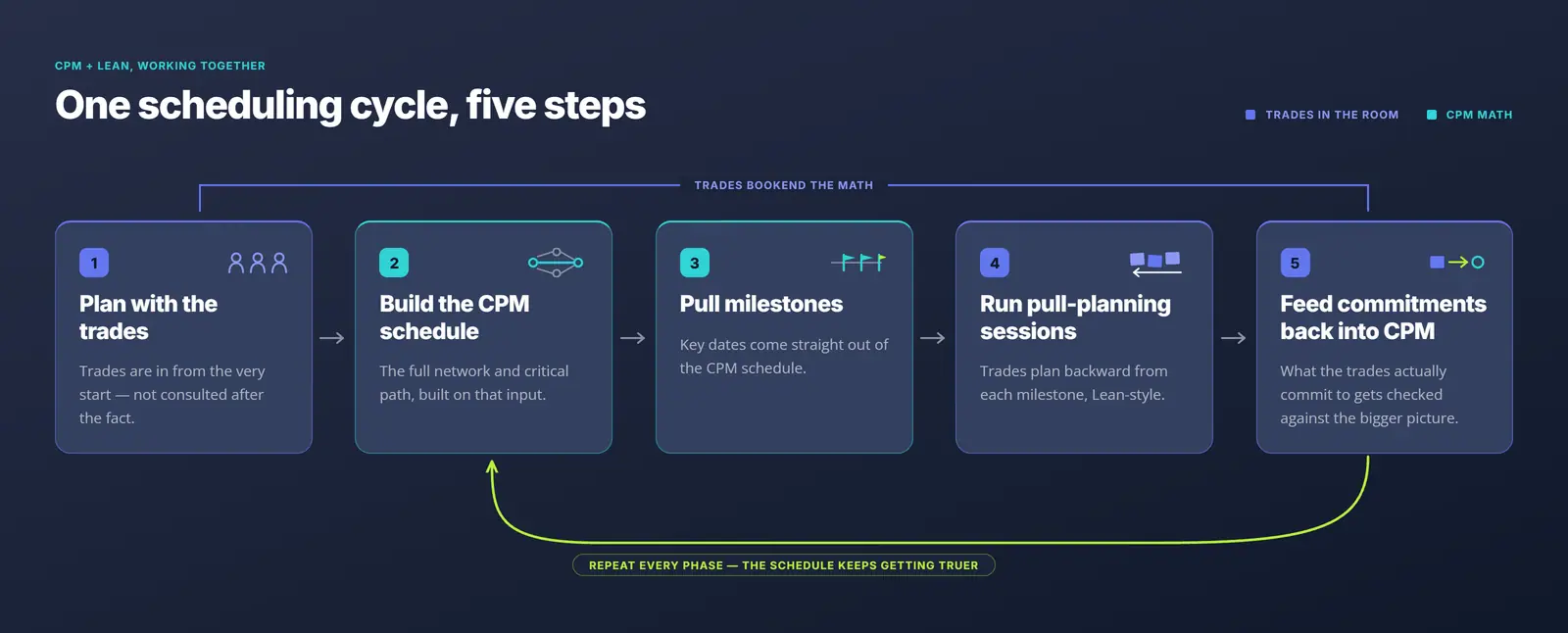
Rogers isn't blind to Lean's real value, though, and this is the part worth sitting with: he explicitly agrees that building a CPM schedule without trade input and then enforcing it as absolute truth "doesn't work" and is a mistake the industry keeps making. His actual proposal isn't "CPM wins", it's a sequence: plan properly with the trades involved from the start, build the CPM schedule, pull milestones from it, run pull planning sessions against those milestones using Lean principles, and then feed whatever the trades actually commit to back into the CPM schedule to see what it does to the bigger picture.
That last step is the whole argument in one sentence: pull planning might genuinely be the best the trades can deliver, but if it moves the project's end date, Rogers wants to know now, while there's still time to shift a later phase, add a shift, or re-sequence something else. A wall of sticky notes, by itself, can't tell you that. Only the CPM network can.
He's not alone in this. Industry writeups on the topic keep landing in similar territory: one construction company's internal case study described the "must choose one" framing as a "false dilemma" entirely, concluding that CPM and Lean each bring the most value in different parts of the same project, not as competitors. Other practitioner sources describe mid sized commercial projects specifically benefiting from CPM providing the owner facing master schedule, with pull planning handling trade level coordination inside it every few weeks.
What Actually Happened When One GC Tried It
Theory is one thing. Here's what an early adopter actually experienced.
Lew Laws, a construction manager who was at DPR Construction (now working for JP Construction) when it was one of the earliest companies to adopt Lean, is refreshingly blunt about it. On paper, he says, the advantages are real, and he singles out just in time delivery specifically as genuinely valuable, fewer logistical headaches, a safer site. But on the core promise, that pull planning would actually change whether a project finished on time, he's not convinced. DPR tried it, refined it, tried it again, project after project, and kept landing on what he calls the "heart attack finish": everything looks fine, fine, fine, until suddenly it isn't, and the team's scrambling to close it out. Same ending, project after project, regardless of how well the process itself was run.
Here's the part worth sitting with, though: even with that same disappointing finish, Laws says the actual experience of working together changed enormously, and for the better. Instead of a schedule handed down from the office, the trades decided week to week what they'd commit to, and answered to each other, not just the GC, when they didn't deliver. He tells the story of a plumber who initially refused to engage, missed his commitments for the first couple of weeks, and then, not because anyone lectured him, but because the other trades waiting on him made their frustration known, became one of the project's loudest advocates for the process. They were making their own calls about their own work, and Laws is clear that visibly changed morale and the working relationships on site, even on a job that still ended in the same scramble as always.
Laws never says Lean fixed his finish dates. He says it changed how people treated each other on the way there. Those are two different things, and a CPM schedule was never going to tell you which one you got.
The Wildcard Nobody Mentioned Yet: Takt Planning
Just to complicate this nicely binary argument: some Lean practitioners don't actually want pull planning to replace CPM, they want a third method, Takt planning, to replace CPM as the master schedule instead, while still using Last Planner System principles underneath it. Takt planning organizes work around a fixed rhythm (a "takt time") that crews move through zones at, borrowed originally from manufacturing, rather than CPM's logic and float calculations. So even inside the "Lean camp," there isn't full agreement on what should replace CPM, if anything should.
We'll be talking about Takt planning more on LinkedIn. Make sure you subscribe to us there to read more.
So, Who's Right?
Genuinely, both camps have real evidence, and the honest answer is probably: it depends what you're building. A single trade interior fit out with a two week duration doesn't need the overhead of a full CPM network. A hundred million dollar hospital project with a two year timeline and a hundred long lead time material orders absolutely does, and pull planning alone won't catch the marble delivery problem three phases from now.
We're not going to tell you which one to pick. That's the whole point of this article. But here's a question worth sitting with either way: if your team is currently running one of these without the other, is that a considered choice, or just what you inherited from whoever built the process before you got there?
Worth an honest look either way.
Ready to take on more premium projects without adding to your overhead?
Lock in your flat-rate, unlimited-user fee with ServiceIQ today.
Start your free trialFrequently asked questions
Keep reading

You Can't Ban Your Way Out of Shadow AI
A dispatch from AGC Tech 2026, where every IT Director in the room had the same idea for stopping unapproved AI use, and the data says it's the wrong one.

AGC Tech 2026 Recap
Notes from the AGC Technology Conference, August 4–6 in Minneapolis: AI bootcamps, a back-office agent named Wendy, and why construction has stopped asking whether to use AI and started asking how.
Ready to take on more premium projects without adding to your overhead?
Lock in your flat-rate, unlimited-user fee with ServiceIQ today.
Start your free trial