
Why AI Might Be the Best Thing to Happen to Construction Hiring
Quick answer: Anthropic's own labor market research ranks construction near the bottom of its AI exposure list, which means entry-level white-collar jobs are narrowing while construction hiring conversations gain leverage. At the same time, McKinsey projects the U.S. needs 520,000 more construction laborers, supervisors, and electricians by 2030, Ford's CEO says the industry was already short roughly 500,000 workers last summer, and data center construction spending is forecast to rise 23% in 2026. Two independent sources pointing the same direction: it's a genuinely good time to be recruiting for the trades, though the data-center hiring surge is concentrated in the construction phase, not a permanent headcount increase at finished facilities.
Key Takeaways
- ●Anthropic's own AI exposure research ranks construction near the bottom of the list, while management, business/finance, and computer/math occupations sit at the top, exactly the entry-level white-collar jobs that used to be a new graduate's default first step.
- ●McKinsey projects the U.S. needs 520,000 more construction laborers, supervisors, and electricians combined by 2030; Ford's CEO says the industry was already short 500,000 workers last summer.
- ●NVIDIA's Jensen Huang called the AI data center buildout the largest infrastructure project in human history, roughly $7 trillion in global capital spend by the end of the decade, and named electricians, plumbers, welders, and construction workers as the ones who'll build it.
- ●Two unrelated sources, an AI company's labor research and a tech CEO's infrastructure comments, landing on the same underlying shift is a stronger signal than either alone.
- ●The caveat: once a data center is built, it employs relatively few permanent workers. The hiring surge is concentrated in the construction phase, not a permanent expansion of the industry's total workforce.
Sara Wharff, writing for Florida AGC, made an argument this year that's worth every construction employer's attention: AI is quietly making your open positions more attractive than they've been in years. Here's the case, and what it actually means for how you hire.
Where Construction Sits on Anthropic's Exposure List
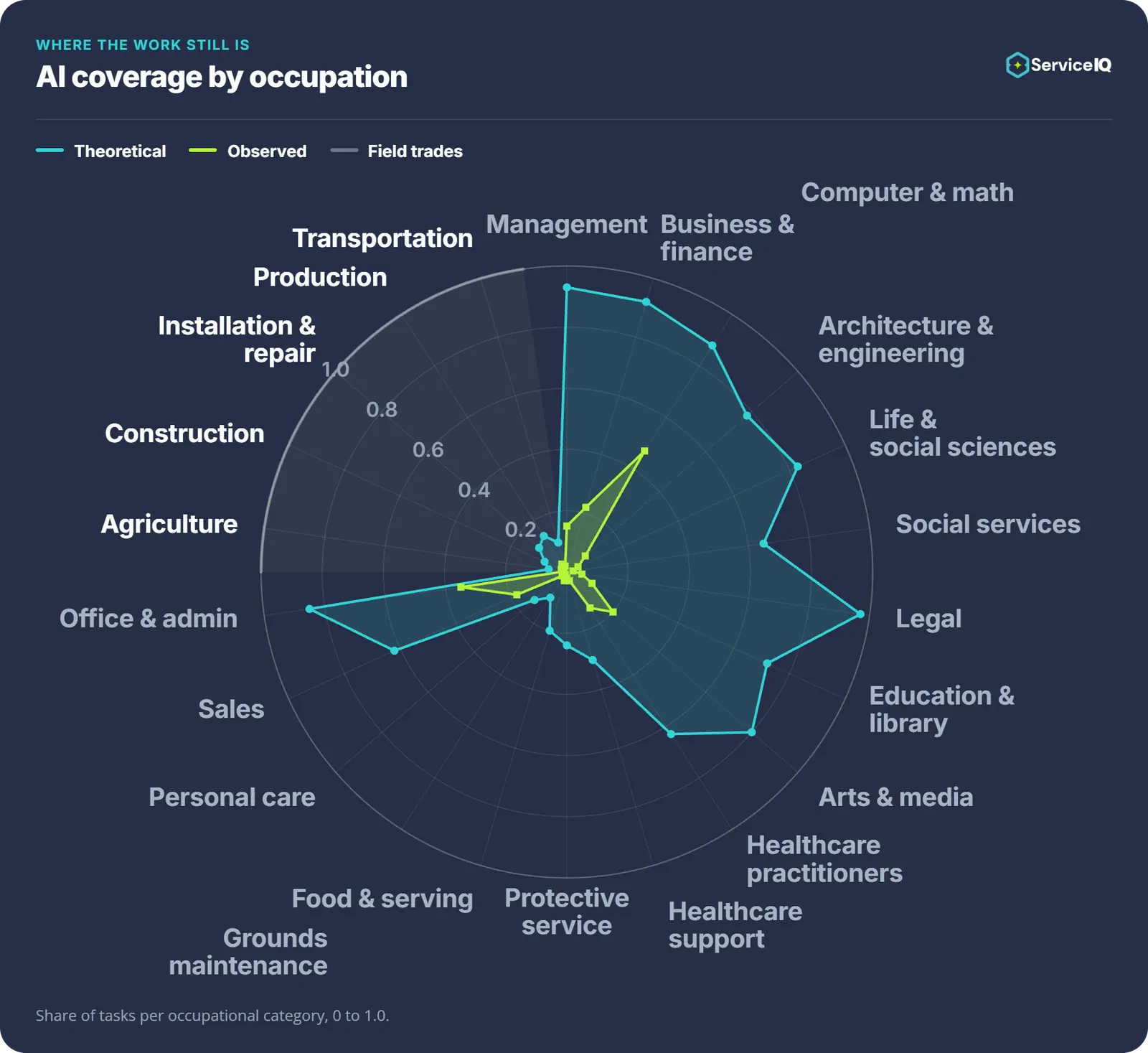
Anthropic, the company behind Claude, publishes its own labor market research mapping which industries show the highest AI exposure, based on real usage data, not speculation. Management, business and finance, computer and mathematical occupations, and architecture and engineering sit at the top of that list, heavy digital, writing, and analysis work, exactly what AI tools are fastest at handling.
Well, we all knew that right? That's not surprising. But, let's now look at your industry…
Construction sits near the bottom, alongside installation and repair, production, transportation, agriculture, and food service. Wharff's piece connects that ranking to something specific and current: hiring is already slowing for young workers in those high-exposure white-collar fields, the entry-level jobs that used to be the automatic first step for a new graduate.
What this means for your hiring specifically: the young person who might have defaulted toward a business degree and an office job five years ago is facing a narrower entry point today. This is already showing up in real hiring data, not a maybe-someday prediction. And it means the pool of people who might genuinely consider a construction career, people who wouldn't have looked twice a few years ago, is bigger than it used to be.
Why the Demand Side Is Real Too
The white-collar door narrowing is only half of this. There's real, independent demand pulling in the same direction too, and it's a big one. At Davos in January 2026, NVIDIA CEO Jensen Huang described the AI data center boom as the largest infrastructure buildout in human history, roughly $7 trillion in global capital spend by the end of the decade, and specifically called out electricians, plumbers, welders, and construction workers as the ones who'll actually build it, many earning six figures without a college degree.
Sure, take a tech CEO's take on your industry with a grain of salt if you want. But the numbers behind his claim don't come from him. McKinsey projects the US needs 130,000 more trained electricians, 240,000 more construction laborers, and 150,000 more construction supervisors between 2023 and 2030. Ford CEO Jim Farley separately noted the US was already short roughly 500,000 construction workers as of last summer. FMI Corp forecasts data center construction spending alone rising 23% in 2026. The Bureau of Labor Statistics projects 9% electrician job growth over the next decade, a pace multiple sources argue won't keep up with actual demand.
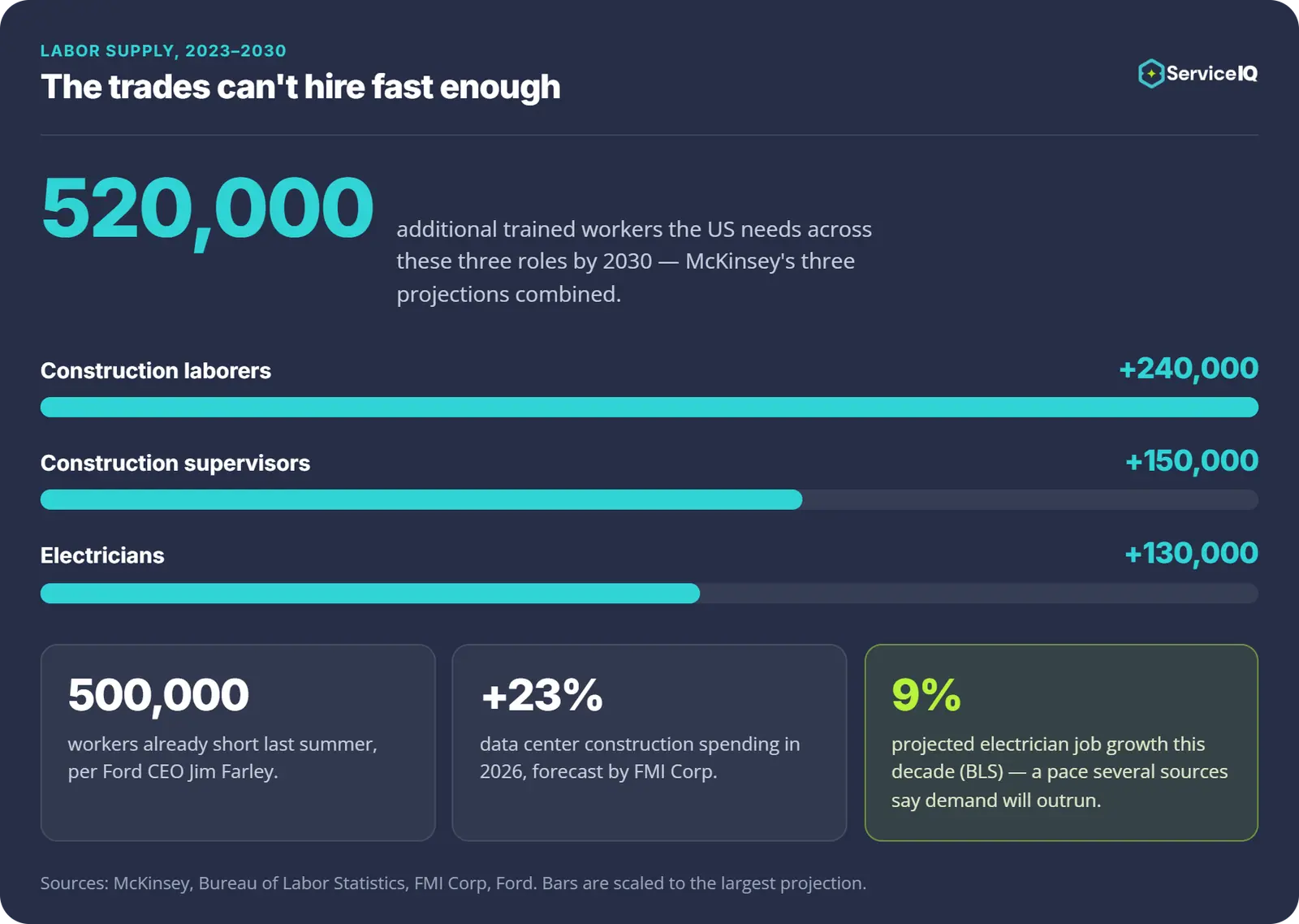
That's not one report making noise. That's four completely different organizations, none of them talking to each other, all pointing the same direction.
This is already happening, not something on the horizon. The labor shortage is current and documented from multiple independent sources, which means the leverage in a hiring conversation with a hesitant candidate has shifted more in your favor than it has in years.
Two Sources, One Real Conclusion
An AI company's own economic research and a tech CEO's infrastructure comments weren't written with each other in mind. One shows white-collar entry narrowing. The other shows skilled trades demand accelerating, with real capital already committed behind it. Two unrelated sources landing on the same underlying shift is a stronger signal than either claim would be alone, and it's exactly the argument Wharff's piece makes directly to construction employers: invest in workforce development and recruiting now, and you're positioned to catch talent that wouldn't have considered this industry a few years ago.
Worth a Real Caveat, Not Just a Victory Lap
Yeah, we know, this is the part that sounds like it's about to undercut all the good news above. It's not going anywhere though, because it's true.
Not every part of this is unambiguously good news. Some coverage of Huang's comments pushed back on the framing: once a data center is actually built, it employs relatively few permanent workers, the hiring surge is concentrated in the construction phase specifically, not a permanent headcount increase at the finished facility. A construction boom tied to data centers is a genuine, current hiring opportunity. It's not the same thing as a permanent expansion of the industry's total workforce, and it's worth keeping that distinction honest when you're making the pitch to a candidate.
What This Actually Means If You're Hiring
The recruiting pitch writes itself, and it's more honest than most industry marketing: the traditional white-collar entry point is narrower than it used to be, skilled trades demand is real and currently under-supplied, and the businesses that update their hiring message now, rather than assuming the old "why would anyone choose construction" objections still hold, are the ones who'll actually catch this shift instead of reading about it after it's already happened.
Want More Like This?
This is exactly the kind of trend we're tracking every week, real research, real numbers, no hype. If you want it in your inbox before it shows up everywhere else, sign up for Toolbox Talk.
Sign Up for Toolbox Talk
Real research, real numbers, no hype, straight to your inbox before it shows up everywhere else.
Ready to take on more premium projects without adding to your overhead?
Lock in your flat-rate, unlimited-user fee with ServiceIQ today.
Start your free trialFrequently asked questions
Keep reading

AI for General Contractors: LLM Guide
GCs juggle six to fourteen software logins just to draft an RFI. A field guide to which LLM, Claude, ChatGPT, Gemini, or Copilot, actually earns its keep on a job site, and where Shadow AI puts your contracts at risk.
AGC Tech 2026 Recap
Notes from the AGC Technology Conference, August 4–6 in Minneapolis: AI bootcamps, a back-office agent named Wendy, and why construction has stopped asking whether to use AI and started asking how.

The Data Center Gold Rush for Small & Mid-Sized GCs
Data center starts hit $77.7B in 2025 (+190% YoY) at $1,033 per square foot. A playbook for small and mid-sized GCs on speed-to-power, decommissioning plans, and winning a seat at the hyperscale table.
Ready to take on more premium projects without adding to your overhead?
Lock in your flat-rate, unlimited-user fee with ServiceIQ today.
Start your free trial