
The Data Center Gold Rush: Can Small and Mid-Sized GCs Strike It Rich?

Quick answer: Yes, but only if small and mid-sized GCs stop competing on square footage and start competing on speed-to-power. With $77.7B in 2025 data center starts, $633M average project cost, and 75 projects worth $130B delayed in Q1 2026 alone, the winners will be firms that master grid-flexible design (EPRI Classes D and E), bake decommissioning plans into their bids, and structure subcontracts to tap the hyperscaler-funded workforce academies.
Key Takeaways
- ●Google turned Meta away on Gemini inference capacity in March 2026, even the giants have run out of physical room.
- ●Data center starts surged to $77.7B in 2025 (+190% YoY); Q4 alone was $44.4B.
- ●Cost per square foot hit $1,033 (up from ~$530); average project cost reached $633M (+70% YoY).
- ●75 projects worth $130B were delayed or blocked in Q1 2026, nearly matching all of 2025's disruptions.
- ●Delay isn't the risk: obsolescence is. A 12-month regulatory pause makes 2025 material quotes worthless.
- ●Utilities like Silicon Valley Power now demand 100% control of the loadside breaker as a non-negotiable interconnection term.
- ●Meta ($115M) and Google ($50M) are training the tradespeople, savvy GCs are restructuring subs to tap those graduates.
The Cloud Sits on a Concrete Slab
The digital world presents an illusion of infinite expansion, but as any veteran project manager will tell you, the "cloud" eventually has to sit on a concrete slab. We are currently witnessing a historic collision between the "limitless" ambitions of the AI revolution and the rigid physical realities of the power grid and data center capacity.
In a market shift that has turned traditional economics on its head, the industry is no longer constrained by demand, but by a sheer, immovable wall of supply. The irony reached a breaking point in March 2026, when Google, despite its massive global footprint, reportedly had to inform Meta that it could not fulfill its request for Gemini inference capacity. When the titans of Big Tech are forced to turn away multi-billion dollar deals because they simply lack the physical floor space and energized compute to host them, the "interconnection queue" is no longer just a line, it’s a battlefield. For general contractors (GCs), this represents a once-in-a-generation pre-con pipeline, provided they can navigate the high-stakes risks of a supply-starved market.
Why Even the Giants Are Running Out of Room
The shortage that disrupted Meta’s internal AI projects highlights a critical pivot in the industry: the "Inference Bottleneck." In the early stages of the AI race, the focus was on training, a massive, one-time construction and compute sprint. Today, the demand has shifted to inference, the 24/7 process of an AI model answering queries or executing tasks. While training happens once, inference happens billions of times daily, creating a permanent, non-negotiable draw on the grid.
Google’s $90 billion infrastructure investment in 2025 proved insufficient to meet the inference needs of its largest customers. Google Cloud currently sits on a performance obligation backlog of more than $460 billion. CEO Sundar Pichai has been blunt: cloud revenue would have been significantly higher if the company simply had more available capacity. This isn’t just a temporary lag; it’s a guaranteed long-term pipeline for firms that can deliver "speed-to-power."
“Agentic AI compute [is projected] to rise 1,000% in just two years.”
From Generative to Agentic
This distinction is vital. While "Generative AI" sparked the initial fire, the shift toward "Agentic AI" (where autonomous agents perform complex, multi-step tasks) is what will drive the next 1,000% increase in compute requirements. This ensures the infrastructure shortage will extend well into the 2030s.
Exploding Costs and Surging Starts
The February 2026 Data Center Report paints a picture of an industry moving at an "endlessly accelerating pace." For GCs, the sheer volume of activity is staggering:
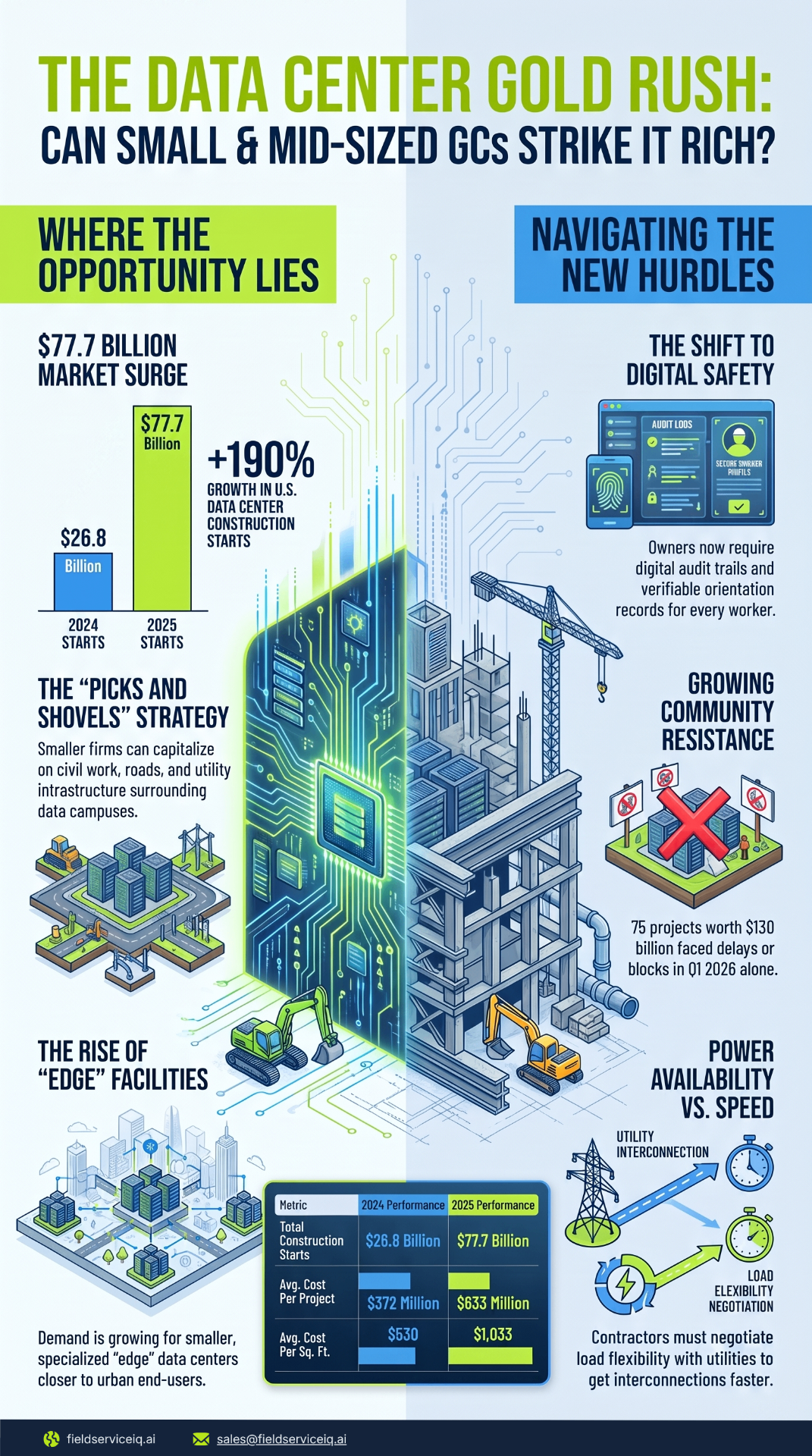
- →190% Year-over-Year Increase: Construction starts skyrocketed to $77.7 billion in 2025.
- →Q4 Momentum: A massive $44.4 billion in starts occurred in the final quarter of 2025 alone.
- →Per-Square-Foot Escalation: Costs have surged to $1,033 per square foot, up from roughly $530 in prior years.
- →The Megaproject Standard: The average project cost has hit $633 million, a 70% increase over 2024.
Margin Erosion and the $600 Million Game
For a strategic analyst, these numbers signal extreme risk. Surging demand translates to surging costs for long-lead items like transformers and switchgear. GCs entering this space face massive "margin erosion" if their cost assumptions become obsolete during the permitting phase. In a $600 million game, liquidated damages tied to schedule slips are no longer a line item. They are a firm-killer.
Five Infographics on the Data Center Gold Rush
Grab the free five-part visual: spend and pipeline, where GCs win and lose on hyperscale jobs, and how to qualify and de-risk pursuits.
Get the Free Data Center InfographicsThe $130 Billion Bottleneck: Community Pushback and Moratoriums
The most significant hurdle to "striking it rich" isn’t the engineering; it’s the local legislation. In Q1 2026 alone, 75 data center projects totaling $130 billion were delayed or blocked, nearly matching the disruptions of the entire previous year.
NIMBY (Not In My Backyard) sentiment has evolved into sophisticated legislative pushback. In Seward County, Nebraska, commissioners recently voted unanimously for a one-year moratorium on data centers, citing:
- →Resource Strain: Excessive water consumption and electricity draw.
- →Quality of Life: Noise pollution from cooling fans.
- →End-of-Life Lifecycle: Growing concerns over "decommissioning" and what happens to these massive shells once they reach obsolescence.
Decommissioning Plans Become Table Stakes
For GCs, the strategic insight is clear: "Decommissioning Plans" are becoming a mandatory requirement for successful bids. As Mark Carter of the Buchalter law firm notes, the danger isn’t just cancellation; it’s that "delays render the contractor’s price and schedule assumptions obsolete." If a project sits in regulatory limbo for 12 months, your 2025 material quotes are worthless by the time you break ground.
Flexibility for Speed as the Negotiating Chip
To bypass grid constraints, hyperscalers are adopting a counter-intuitive strategy: giving up control to get built faster. Under the Electric Power Research Institute (EPRI) "FlexMosaic" and "DCFlex" initiatives, the industry is moving toward "Grid-Responsive" designs.
The three pillars of this flexibility include:
- Managed Workloads: Pausing non-critical training or redirecting inference queries to less-stressed regional sites.
- Reduced AI Plant Consumption: Granular control over cooling and IT loads.
- On-site Backup Power: Utilizing onsite generation to support the grid during peak stress.
The Aurora Template and the Loadside Breaker
The Aurora AI Factory in Manassas, Virginia, set to come online in late 2026, serves as the industry template for this era. However, this shift creates a new technical tension for GCs. Utilities like Silicon Valley Power now demand "100% control of the loadside breaker" as a non-negotiable condition for faster interconnection.
This introduces significant Hardware Risk; data centers require gradual load reduction to protect highly sensitive server arrays. As a GC, your job is to manage the installation of the automated, granular controls that prevent an "instantaneous trip" from frying half a billion dollars in hardware.
The Skills Gap: Titans Are Training Their Own Competition
With $88 billion in pre-construction projects tracked for the next six months, the labor shortage is the ultimate governor on growth. Big Tech is no longer waiting for the market to provide; they are manufacturing their own tradespeople. Google has pledged $50 million for skilled trades, and Meta has launched a $115 million workforce academy that offers free credentials and "guaranteed jobs."
For mid-sized GCs, the strategic move is not to compete with these "Titans" on recruitment. Instead, savvy firms are restructuring their subcontracts to specifically tap into these academy graduates, leveraging the massive training budgets of the hyperscalers to bolster their own jobsite productivity.
Is There Room at the Table?
The data center gold rush is entering a mature, more dangerous phase. The 2026 pipeline is robust, but the winners will not be the firms that can pour the most concrete; they will be the firms that can innovate their way through the power bottleneck.
The industry has reached a crossroads where "Speed-to-Power" is the only metric that matters. This leads to a provocative strategic question for every GC in the pre-con phase: Are you prepared to design and build facilities that cede 100% control of the loadside breaker to the utility? In 2026 and beyond, your willingness to accept that trade-off may be the only way to secure a seat at the table.
Are Data Centers a Gold Mine for GCs?
Five free infographics distilling the data-center opportunity (spend, speed-to-power, moratoriums, grid flexibility, and workforce strategy) into a single download.
Download the Free InfographicsReady to take on more premium projects without adding to your overhead?
Lock in your flat-rate, unlimited-user fee with ServiceIQ today.
Start your free trialFrequently asked questions
Keep reading

The 2026 AI Infrastructure Supercycle
The cloud has hit the ground. A 2026 overview of the AI infrastructure supercycle: $700B hyperscaler spend, the training-to-inference pivot, FlexMosaic, local moratoriums, and the workforce race.

Why Agility Beats Scale
Speed-to-power beats square footage. A GC playbook for winning distributed inference builds through EPRI Class D/E flexibility, modular construction, and civil partnerships that clear community moratoriums.

The $700 Billion Ceiling
Five surprising realities behind the $700B AI infrastructure war: from Google turning Meta away to the $1,033 square foot, Nebraska moratoriums, and the loadside-breaker kill switch.
Ready to take on more premium projects without adding to your overhead?
Lock in your flat-rate, unlimited-user fee with ServiceIQ today.
Start your free trial