
You Already Know Agile vs. Waterfall. You Just Didn't Know It Was About Construction Too.
Quick answer: Agile and Waterfall aren't just software development frameworks: they map directly onto delivery methods construction already uses. Waterfall, formally described by Winston Royce in 1970, is structurally identical to Design-Bid-Build: strict, sequential phases with zero overlap. Agile, born from software teams' 2001 manifesto, mirrors Design-Build, CMAR, IPD, and Lean construction's pull planning, all of which allow iterative, adaptive cycles instead of a schedule handed down months in advance. The two industries arrived at the same rigid-versus-adaptive divide independently, decades apart, and the data backing Agile's advantage in software, the Standish Group's CHAOS Report found Agile succeeding at roughly three times the rate of Waterfall, has a direct parallel in why Design-Build and Lean pull planning often outperform a rigid, CPM-only schedule.
Key Takeaways
- ●Waterfall (formally described in 1970 by Winston Royce) and Design-Bid-Build are structurally the same idea: strict, sequential phases with no overlap, applied to two different industries decades apart.
- ●The 2001 Agile Manifesto's iterative, feedback-driven cycles mirror what Design-Build, CMAR, and IPD already do, plus Lean construction's pull planning, which lets trades replan week to week instead of following a schedule handed down months in advance.
- ●The Standish Group's 2020 CHAOS Report found Agile succeeding at roughly three times the rate of Waterfall (42% versus 13%); other studies (Ambysoft's 2013 survey, a Khoza and Marnewick 2020 analysis) found different exact numbers, but every one points the same direction.
- ●Construction didn't borrow Agile from software: both industries hit the same wall, rigid upfront planning breaking down the moment reality doesn't match the plan, and arrived at similar answers independently.
- ●The strongest real-world answer for both isn't picking a side. It's combining CPM's big-picture visibility with Lean's trade-level adaptability, the same "Agifall" hybrid some software teams already run.
If you've spent any time around business or tech content in the last decade, you've probably heard "agile" and "waterfall" thrown around, usually about software teams, sprints, standups, that world. Here's the part nobody tells you: those two frameworks map almost exactly onto delivery methods you already use every day. You already understand why Design-Build works the way it does. You just know it under a different name.
Where Waterfall Actually Came From
Waterfall, the strict, sequential, one-phase-finishes-before-the-next-begins approach, was formally described in 1970 by Winston Royce. Each phase, requirements, design, build, test, delivery, has to fully complete before the next one starts. No overlap, no going back without real disruption. It's predictable and easy to plan, right up until something's wrong and you don't find out until you're already several phases past where the problem started.
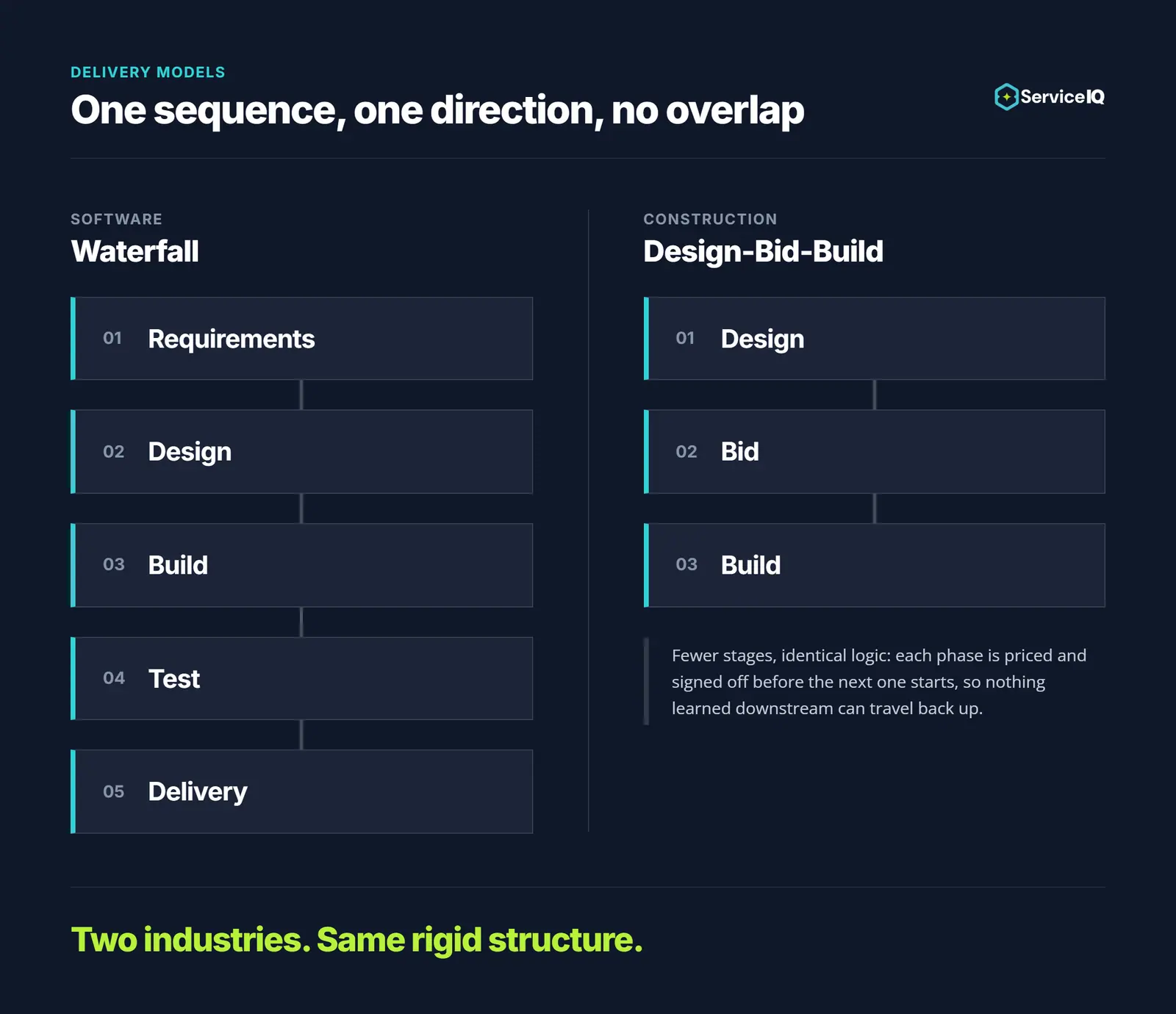
Sound familiar? It should. In "Scheduling for Different Project Delivery Methods," we covered Design-Bid-Build as strictly sequential, design finishes completely, then bidding happens, then building happens, with zero overlap allowed. That's not a loose analogy. DBB and Waterfall are structurally the same idea, applied in two completely different industries, decades apart.
Why Software Walked Away From It
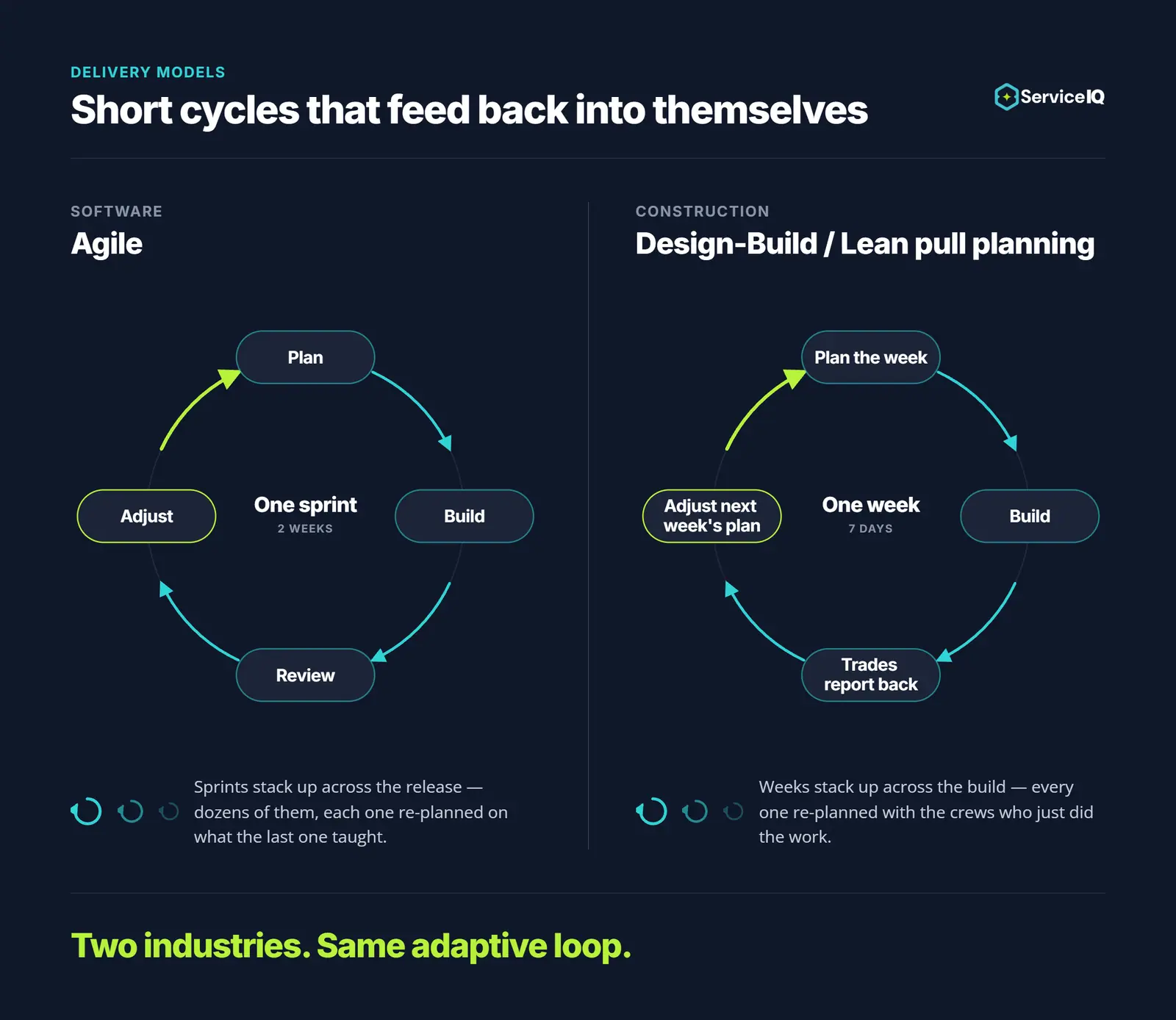
By the early 2000s, software teams were fed up with exactly this problem, and in 2001 a group of developers wrote the Agile Manifesto, favoring iterative cycles, continuous feedback, and the ability to adjust course without blowing up the whole schedule.
The data backing that shift up is remarkably consistent across more than a decade of independent studies. The Standish Group's CHAOS Report, one of the most cited sources on software project outcomes, has repeatedly found Agile projects succeeding at roughly three times the rate of Waterfall projects, in its 2020 report, 42% for Agile versus 13% for Waterfall. Other studies over the years have found different exact numbers, Ambysoft's 2013 survey put it at 64% versus 49%, another analysis found 88.2% versus 47%, but every single one points the same direction. Agile wins, consistently, regardless of which year or which researcher ran the numbers.
The Construction Parallel Nobody's Drawing
Design-Build, CMAR, and IPD all allow the kind of overlap and adaptability Waterfall never could, exactly what Agile brought to software. And in "CPM vs. Lean Scheduling," we covered how Lean construction's pull planning gives trades a way to plan and adjust week to week instead of following a schedule handed down from on high months in advance. That's the same underlying idea Agile brought to software teams, just developed independently, inside construction, on its own timeline.
That's genuinely worth sitting with. Construction didn't borrow Agile from software. Two completely different industries ran into the same core problem, rigid upfront planning breaks down the moment reality doesn't match the plan, and arrived at strikingly similar answers on their own.
Why This Actually Matters for You
If you've ever sat through a webinar or read an article about why software teams switched to Agile, you already have an intuitive case for why Design-Build often beats DBB on a fast-moving project, and why Lean pull planning can outperform a rigid CPM schedule handed down without trade input. The vocabulary's different. The logic underneath it is the same argument, made twice, by two industries that never talked to each other.
Even the messy middle ground has a parallel. One consultant quoted in industry coverage calls their hybrid approach "Agifall," part rigid upfront planning, part adaptive execution. That's not so different from the actual conclusion of our own CPM versus Lean piece: combine the big-picture visibility of CPM with the trade-level adaptability of Lean, rather than picking one team and swearing off the other entirely.
Sometimes the freshest way to understand your own industry is a framework somebody else already built, in a completely different one, solving the exact same problem.
Want More Like This?
This is exactly the kind of connection we like digging into every week, real research, real numbers, no hype. If you want it in your inbox before it shows up everywhere else, sign up for Toolbox Talk.
Sign Up for Toolbox Talk
Real research, real numbers, no hype, straight to your inbox before it shows up everywhere else.
Ready to take on more premium projects without adding to your overhead?
Lock in your flat-rate, unlimited-user fee with ServiceIQ today.
Start your free trialFrequently asked questions
Keep reading

CPM vs. Lean Scheduling
Does Lean construction complement the Critical Path Method, or replace it entirely? A construction management veteran, an early Lean adopter, and the data all land in a similar place.

Project Delivery Methods & Scheduling
Design-Bid-Build, Design-Build, CMAR, and Integrated Project Delivery each schedule differently, and the method you pick decides your schedule before a single stake goes in the ground.

Construction Manager vs. Project Manager
Ray and Priya both assumed someone else said yes to a Saturday pour. Nobody did. What actually separates a Construction Manager from a Project Manager, and why the same job title means two different jobs under CMAR.
Ready to take on more premium projects without adding to your overhead?
Lock in your flat-rate, unlimited-user fee with ServiceIQ today.
Start your free trial