
Scheduling for Different Project Delivery Methods

Quick answer: Design-Bid-Build, Design-Build, Construction Manager at Risk, and Integrated Project Delivery each schedule differently because each one decides when the contractor joins and how much design and construction are allowed to overlap. DBB is strictly sequential and allows no fast tracking. Design-Build and CMAR allow real fast tracking through a single team or phased bid packages. IPD allows the most aggressive overlap of all four because every party is at the table from day one.
Key Takeaways
- ●The delivery method you pick decides your schedule before design even starts, not the other way around.
- ●Design-Bid-Build is strictly sequential and allows zero fast tracking, since a fixed price needs a complete set of drawings first.
- ●Design-Build and Construction Manager at Risk both allow real fast tracking, through a single unified team or through phased bid packages.
- ●Integrated Project Delivery allows the most aggressive schedule overlap of the four, and pairs most naturally with Lean pull planning.
- ●What triggers mandatory competitive bidding is public funding and public ownership, not how commercial a project feels, and states like Texas now allow Design-Build and CMAR for public work too.
Before a Single Stake Goes in the Ground
Let's be honest: "project delivery methods" is not a phrase that gets anyone's pulse up. It sounds like something you'd find in a procurement manual, filed somewhere between "insurance certificates" and "the meeting that could have been an email." But here's the thing nobody tells you early enough in your career: the delivery method you pick decides your schedule before a single stake goes in the ground. Not after. Before. It's the decision that decides how much control you'll have over every other decision.
So let's actually dig into it: Design-Bid-Build, Design-Build, Construction Manager at Risk, and Integrated Project Delivery, how each one schedules differently, and why picking the wrong one for your project is like bringing a Gantt chart to a knife fight.
The Quick Comparison
| Delivery Method | When the Contractor Joins | Scheduling Style | Fast-Tracking? | Best Fit |
|---|---|---|---|---|
| Design-Bid-Build (DBB) | After design is 100% complete | Strictly sequential: design, then bid, then build | Not possible | Public projects with bidding requirements, well-defined scope |
| Design-Build (DB) | From day one, same contract as the designer | Design and construction overlap freely | Yes, most naturally of the four | Owners who want speed and a single point of contact |
| Construction Manager at Risk (CMAR) | During design, as a paid advisor, later converts to at-risk builder | Phased bid packages, built around a Guaranteed Maximum Price | Yes, through bid packages | Complex projects that need early cost certainty and owner control |
| Integrated Project Delivery (IPD) | Day one, bound into one shared multi-party contract | Fully collaborative, often paired with Lean pull-planning | Yes, most aggressively | Projects where every party is genuinely willing to share risk and reward |
Design-Bid-Build: The One Everyone Learned On
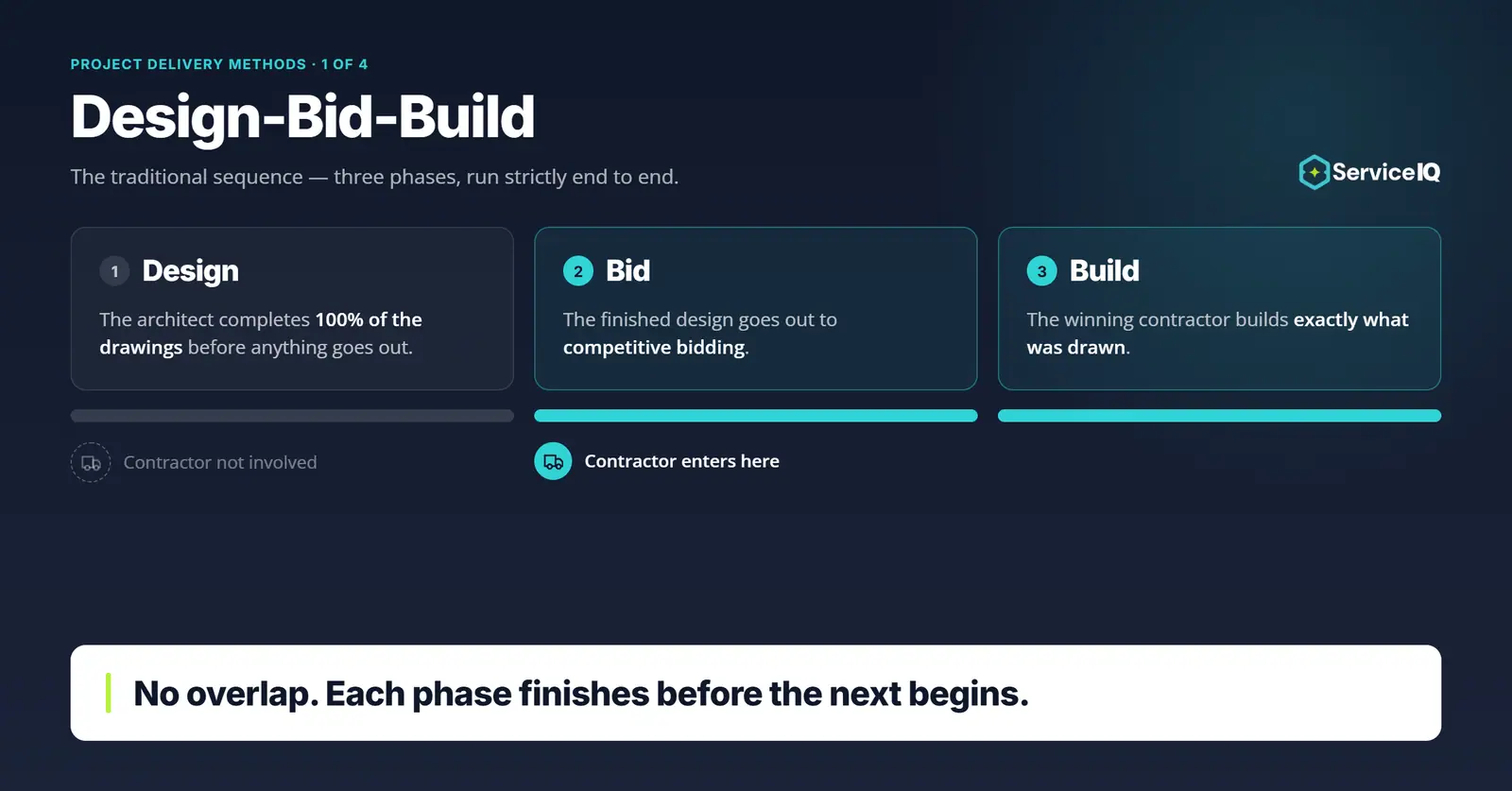
DBB is the granddaddy of delivery methods, and it schedules exactly like you'd expect from something that's been around since before Gantt charts were drawn by hand. Design finishes completely. Then it goes out to bid. Then whoever wins builds exactly what the drawings say. One phase ends before the next one starts, full stop, no overlap, no exceptions.
The scheduling upside is that it's simple to understand and predictable to plan, once you're in the build phase, you know exactly what you're building and roughly how long each piece should take. The downside is baked into the sequence itself: because the contractor isn't in the room during design, nobody's catching the constructability problems, the "wait, how are we actually supposed to build this corner detail" moments, until construction's already underway. That shows up later as RFIs, change orders, and delays that a design-phase conversation could have caught for free.
Fast-tracking, overlapping design and construction to save time, is basically impossible here. You can't put a fixed price on a half-finished set of drawings, so the whole method depends on waiting until the design is done before anyone commits to a schedule at all. This is why DBB is quietly becoming the exception rather than the rule on large, complex, schedule-sensitive work, even though it's still the default for public projects where competitive bidding is a legal requirement, not a preference.
Design-Build: One Contract, One Team, One Schedule
Design-Build flips DBB's biggest weakness into its whole selling point: the designer and the builder are the same team, under the same contract, from the very beginning. That means they don't need a complete, legally bulletproof set of construction documents before work starts. They just coordinate internally, and construction can begin on the parts that are settled while the rest of the design is still being finished.
That's a genuinely different scheduling philosophy: instead of one long line of sequential phases, you get overlapping tracks moving at once. It's usually the fastest of the four methods, and it comes with a real advantage of having a single point of responsibility, no finger-pointing between architect and contractor about whose fault a delay was, because they're the same outfit.
The tradeoff is flexibility. Once a Design-Build team is moving, significant mid-project changes are harder to absorb than they would be in a method where the owner has more direct control over the design team. And some owners genuinely dislike the feeling of pre-selecting one team and hoping they got it right, since there's no separate, independent design check on the builder's own work.
Construction Manager at Risk: Get the Builder in the Room Early, Keep Two Contracts
CMAR is the compromise position, and like most compromises, it's trying to get the best of both worlds without fully giving up either one. The owner still contracts separately with a designer, keeping that direct relationship DBB owners are used to, but also brings on a Construction Manager early, during design, purely as a paid advisor at first: estimating, scheduling input, constructability reviews, the stuff that catches expensive problems while they're still just lines on paper.
Once design has progressed enough, that same CM converts into the actual at-risk builder, committing to a Guaranteed Maximum Price before the design package is even fully finished. Scheduling under CMAR usually happens through phased bid packages, early trades get released to bid and start work while later-phase design is still being finalized, which gives you real fast-tracking capability without fully handing the whole thing over to a single design-build entity.
The catch: this only works if the owner stays genuinely engaged through design, and if there's real trust in the CM's numbers and judgment. A CMAR relationship with a CM who isn't transparent, or an owner who checks out during the design phase, tends to produce the exact GMP-versus-reality arguments the method was supposed to prevent.
Integrated Project Delivery: Everyone's In, From Day One
IPD is the one that sounds almost too idealistic to be real, and for a lot of owners, it kind of is. Owner, architect, and key builder are all bound into a single multi-party contract from the very start, sharing risk and reward collectively rather than each party protecting their own slice of the budget. Scheduling under IPD tends to be the most collaborative of the four, decisions get made jointly, early, with everyone who'd normally be arguing about a change order two years from now sitting in the same room today instead. It's also the delivery method most naturally paired with Lean scheduling principles like pull planning, for reasons that probably won't surprise anyone who's read the rest of this scheduling series (we have an article on Lean and Critical Path scheduling if you're interested).
Here's the honest catch, though, and it's worth saying plainly: IPD asks for a level of trust and shared risk that a lot of owners say they want right up until they're actually asked to sign it. Plenty of people love the idea of IPD's collaborative upside without loving the idea of sharing in its downside, and that mismatch is a big part of why it's still the least common of the four methods, despite arguably having the strongest scheduling logic behind it.
What This Actually Means for Your Schedule
Strip away the relationship talk for a second and look at the actual scheduling mechanics, because they genuinely differ, not just in feel, in how risk and technique both work.
- Fast-tracking capability, ranked: IPD allows the most aggressive overlap of any method, precisely because everyone's already at the table when the first draft gets sketched. Design-Build is close behind, one contract, one team, no external document handoff required before work can start. CMAR allows real fast-tracking too, but through structured bid packages rather than free-flowing overlap, early trades get released while later design is still being finished. DBB allows none of it. Zero. The whole method depends on a complete, fixed set of drawings existing before anyone commits to a price or a schedule.
- Who actually owns the schedule risk: This is the part contracts departments care about and scheduling departments live with. Under DBB, the contractor absorbs schedule risk the moment they sign, based on documents they had no hand in shaping, which is exactly why RFIs and change orders pile up mid-project. Under CMAR, schedule risk gets negotiated into the Guaranteed Maximum Price before construction starts, so at least it's priced in rather than discovered later. Design-Build keeps schedule risk inside one entity, which sounds cleaner until that entity has a bad month and there's no independent party to catch it. IPD spreads schedule risk across everyone in the multi-party contract, which is either the fairest arrangement of the four or the hardest one to actually enforce, depending who you ask.
- Which scheduling technique actually fits: DBB's rigid, no-overlap structure is the natural home for straight CPM, there's no phase overlap to manage collaboratively, so the network diagram does all the real work on its own. CMAR and Design-Build, with their phased and overlapping structures, tend to benefit from CPM handling the big picture while Lean pull planning runs the week-to-week trade coordination inside each phase, the same "combine both" argument our CPM-versus-Lean piece made. IPD is the method built almost entirely around Lean principles from day one, which is why it's the delivery method most often paired with the Last Planner System specifically. That's not a coincidence, the contractual structure and the scheduling philosophy were built by people solving the same underlying problem from two different directions.
One More Wrinkle: What You're Actually Allowed to Use
Here's a detail worth getting precise about, because it's easy to slightly misstate: it's not "commercial jobs must be DBB." It's public versus private, funding and ownership, not building type. A privately developed office tower, a private hospital, a shopping center, doesn't matter how "commercial" it is, the owner retains full discretion and can pick any of these four methods freely. What actually triggers mandatory competitive bidding law is public money and public ownership: a school, a courthouse, a municipal building, funded by taxpayers.
And even that's been loosening. Texas, for instance, has a statute (Government Code Chapter 2269) that now explicitly authorizes Design-Build and CMAR for public projects too, just through a more structured qualifications-plus-price process than a straight low-bid award. "Public means DBB, full stop" isn't universally true anymore, it genuinely depends on the state, and the trend over the last couple decades has been toward more flexibility for public owners, not less.
Project size and type affects scheduling in a more practical way than the legal question does. IPD shows up almost exclusively on large, complex, often healthcare-related private projects, the contractual overhead of setting up a genuine multi-party shared-risk agreement usually isn't worth it below a certain size. CMAR tends to concentrate on complex institutional or private work where early cost certainty matters enough to justify bringing a CM on board during design, not usually the right call for a straightforward, well-defined small job. Design-Build scales reasonably well across sizes but shows up most often wherever speed is the actual priority. DBB stays common across every size category, partly because it's still the default wherever competitive bidding is legally required, and partly because it's genuinely the simplest option for well-defined, low-ambiguity scope, regardless of how big or small the job is.
The upshot: picking the "right" method isn't just a trust question or a speed question. Sometimes it's a legal question you don't get a vote on, and separately, a question of whether a project is big and complex enough to justify a heavier contractual structure in the first place.
Let's Keep This Going
If you've worked under more than one of these, you already know the theory only gets you so far, the real differences show up the first time a schedule slips and everyone has to figure out whose contract actually covers what happens next. We'd genuinely like to hear how it played out for you. Drop a comment, or find us on LinkedIn and let's keep the conversation going there.
Ready to take on more premium projects without adding to your overhead?
Lock in your flat-rate, unlimited-user fee with ServiceIQ today.
Start your free trialFrequently asked questions
Keep reading

CPM vs. Lean Scheduling
Does Lean construction complement the Critical Path Method, or replace it entirely? A construction management veteran, an early Lean adopter, and the data all land in a similar place.

Job Costing for Profitability
A controller's guide to construction job costing: direct vs. indirect costs, committed costs, the 10-step estimating process, and the WIP reporting that reveals over- and under-billing.

Strategic Business Frameworks for Construction
A real EOS Worldwide case study on a Central Florida construction company shows what it actually takes to stop a growing business from running entirely through one owner.
Ready to take on more premium projects without adding to your overhead?
Lock in your flat-rate, unlimited-user fee with ServiceIQ today.
Start your free trial