
The $700 Billion Ceiling: 5 Surprising Realities of the AI Infrastructure War

Quick answer: The AI infrastructure war has hit a $700B ceiling defined by physical limits, not capital. Five realities are reshaping the industry: (1) Google turned Meta away on inference capacity; (2) agentic AI is a permanent, always-on grid load; (3) data-center costs hit $1,033 per square foot; (4) $130B of projects were delayed in one quarter over community pushback; and (5) hyperscalers are handing utilities the loadside-breaker kill switch just to get built faster.
Key Takeaways
- ●March 2026: Google told Meta "no" on Gemini inference capacity. A first for the hyperscale era.
- ●Google Cloud is sitting on a $460B backlog of frustrated revenue.
- ●Agentic AI is projected to need 1,000% more compute than generative AI within two years.
- ●Data-center cost per square foot hit ~$1,033 (up 95% YoY); average project cost hit $633M (+70%).
- ●75 projects worth $130B were delayed or blocked in Q1 2026 alone.
- ●Hyperscalers are ceding kill-switch control of the loadside breaker to utilities to gain speed-to-power.
- ●The Big 4 will spend a collective ~$710B on AI infrastructure this year alone.
When Google Told Meta "No"
In March 2026, the era of infinite digital scale came to a grinding halt. Meta Platforms approached Google with a massive request for Gemini inference capacity, only to hear a word previously unheard in the hyperscale lexicon: "No." Google simply didn’t have the physical room to fulfill the order.
This seismic shift indicates that AI demand has finally outstripped the physical world’s ability to house it. Behind the digital curtain, the revolution is no longer about ethereal code; it is a brutal struggle of concrete, copper, and cooling fans. We are witnessing the moment where capital alone can no longer build a way out of a supply crisis.
The shortage disrupted several of Meta’s internal AI projects, forcing the social media giant to prioritize its workloads like a manufacturer rationing raw steel. This is the new reality of the AI economy. It is a world where the primary currency is no longer cash, but power and permits.
1. Even the Giants Are Running Out of Room
The Google-Meta incident is a landmark case study for any tech-economy strategist. Google invested a staggering $90 billion in infrastructure in 2025 and is on track to double that figure for 2026. Yet, even this historic flood of capital was insufficient to meet the inference needs of a single major peer.
For Wall Street, the most alarming metric is the "frustrated revenue" trapped in the balance sheets. Google Cloud currently carries a performance obligation backlog of more than $460 billion, representing a mountain of signed contracts that cannot yet be realized due to physical capacity constraints.
“Cloud revenue would have been higher if Google had more available capacity.”
A Bottleneck Money Cannot Lubricate
This backlog is a massive liability disguised as demand. It proves that the "Big Tech" spending spree has reached a bottleneck that money cannot lubricate. When the world’s most liquid companies are turned away for lack of space, it signals that the infrastructure war has moved from the boardroom to the job site.
2. Why Agentic AI Changes the Math
The industry is pivoting from a "training bottleneck" to an "inference bottleneck." Training a model is a massive, one-time event, but inference, the actual use of the model, happens billions of times daily. As AI moves from generating text to "Agentic AI," the math of the power grid fundamentally breaks.
Unlike standard generative queries that end after a response, Agentic AI acts as an autonomous assistant, creating an "always-on" load that never stops consuming compute cycles. Nvidia CEO Jensen Huang projects that this shift will require 1,000% more compute than generative AI within just two years.
This 1,000% surge creates a permanent infrastructure shortage that the current grid is not designed to handle. Compute has effectively become a new "scarce resource," much like oil or rare earth metals. In this environment, the ability to run a model is becoming more valuable than the model itself.
Five Infographics on the Data Center Gold Rush
The five surprising realities of the AI infrastructure war, distilled into shareable visuals.
Get the Free Data Center Infographics3. The $1,033 Square Foot: The Hidden Cost of Groundbreakings
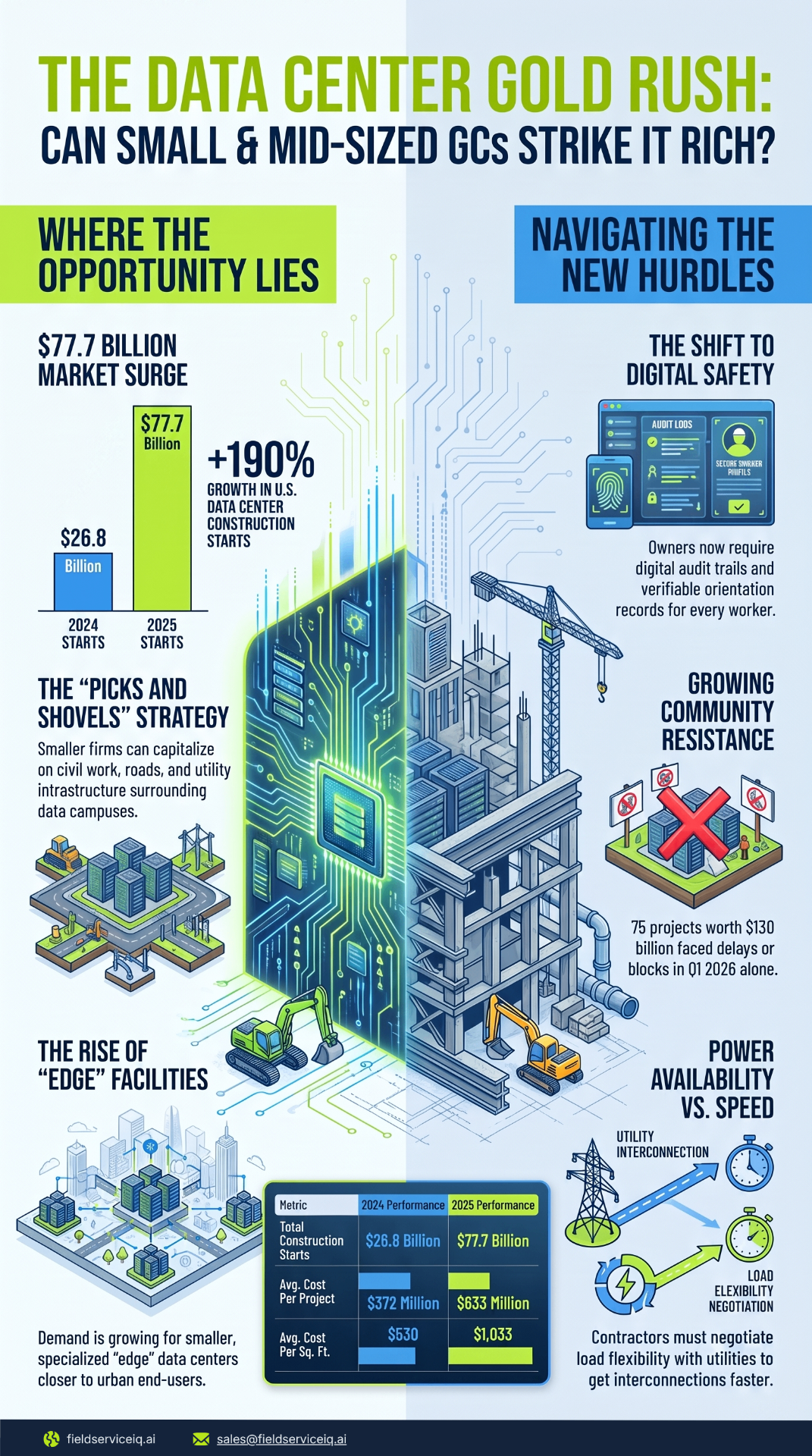
The economic volatility of building these "AI factories" is nothing short of breathtaking. According to ConstructConnect, data center construction starts surged to $77.7 billion in 2025, a 190% year-over-year increase. However, the cost to play in this league has nearly doubled in twelve months.
The average data center project cost rose 70% in 2025, reaching $633 million per facility. Most tellingly, the cost per square foot hit an estimated $1,033, a staggering 95% increase from the $530 average seen just a year prior. We are seeing a "gold rush" pricing model that threatens the margins of even the wealthiest players.
While the "Big 4" hyperscalers are projected to spend a collective $710 billion this year alone on AI infrastructure, they are facing diminishing returns. High entry costs and construction delays mean that only those with the deepest pockets can survive, yet even they are struggling to maintain their delivery schedules.
4. The Nebraska Freeze: When Communities Say "No"
The supply crunch is being exacerbated by a rising tide of public opposition that the industry was unprepared for. In the first quarter of 2026 alone, 75 data center projects worth roughly $130 billion were delayed or blocked. Communities are no longer viewing these facilities as "tech hubs," but as resource-draining monoliths.
In Nebraska, Seward, Otoe, and Gage counties have imposed moratoriums on new data center development. Local officials are increasingly wary of the "megaproject" footprint, citing legitimate concerns over noise from cooling systems and the massive strain on water and electricity supplies.
Beyond immediate resource use, a "circular economy" question is emerging: what happens to these massive, power-hungry shells at the end of their lives? These community grievances have the power to halt billion-dollar pipelines. The industry is learning that a data center cannot exist in a vacuum; it must negotiate its right to exist with its neighbors.
5. The "Flexibility" Trade-Off: Speed Over Control
To bypass the gridlock, developers are adopting a survival strategy known as "Load Flexibility." Through frameworks like EPRI’s FlexMosaic, data centers are trading their autonomy for "Speed-to-Power." They are offering to "pause" or "slow down" workloads by 18% to 55% in exchange for faster interconnection to the grid.
This creates a radical shift in the power dynamic between Big Tech and local utilities. To secure additional capacity, data centers must now grant utilities a "kill switch", direct control over the facility’s demand during peak times. The most powerful companies on Earth are becoming subservient to local utility operators.
“SVP [Silicon Valley Power] must also have the safety net of 100% control of the loadside breaker if the data center wants to have the faster interconnection and additional capacity. That is non-negotiable.”
The Price of External Throttling
The irony is profound. The most advanced technology in human history is being forced to accept external "throttling" just to keep the lights on in local neighborhoods. This loss of sovereignty is the price the AI industry must pay to keep its engines running.
The Next Frontier of the Boom
The AI boom has transitioned from a software challenge to a physical resource war involving land, water, and power. The winners of the next decade will not be the companies with the cleverest algorithms, but those who can master the "flexible" infrastructure required to navigate a constrained world.
Investors must look beyond the chipmakers to the builders of "grid-interactive" assets. As we hit the $700 billion ceiling, the industry’s survival depends on coexistence rather than just expansion. The scarcity of physical resources has become the ultimate regulator of the digital age.
As AI begins to require 1,000% more power, a final question remains for the strategists: Will our physical world adapt to the technology, or will the technology be forced to shrink to fit the world?
Are Data Centers a Gold Mine for GCs?
Five free infographics on the $700B ceiling (the spend, the bottleneck, the moratoriums, and the loadside-breaker trade-off) built for GC leaders.
Download the Free InfographicsSee ServiceIQ run your service operation
Dispatch, work orders, customer history, and billing on one platform, built for contractors growing past whiteboards and group texts.
Get started freeFrequently asked questions
Keep reading

The Data Center Gold Rush for Small & Mid-Sized GCs
Data center starts hit $77.7B in 2025 (+190% YoY) at $1,033 per square foot. A playbook for small and mid-sized GCs on speed-to-power, decommissioning plans, and winning a seat at the hyperscale table.

The 2026 AI Infrastructure Supercycle
The cloud has hit the ground. A 2026 overview of the AI infrastructure supercycle: $700B hyperscaler spend, the training-to-inference pivot, FlexMosaic, local moratoriums, and the workforce race.

Why Agility Beats Scale
Speed-to-power beats square footage. A GC playbook for winning distributed inference builds through EPRI Class D/E flexibility, modular construction, and civil partnerships that clear community moratoriums.
See ServiceIQ run your service operation
Dispatch, work orders, customer history, and billing on one platform, built for contractors growing past whiteboards and group texts.
Get started free