
The 2026 AI Infrastructure Supercycle: Reconciling Ethereal Ambition With Physical Limits

Quick answer: The 2026 AI infrastructure supercycle is the moment ethereal AI ambition slammed into physical limits: grid, land, water, and labor. The Big 4 hyperscalers will spend roughly $700B this year alone, yet Google still had to decline Meta’s Gemini inference request in March. The bottleneck has moved from capital to construction, and the winners are firms that can build, energize, and negotiate load flexibility fast enough to matter.
Key Takeaways
- ●The cloud is no longer weightless. 2026 is when AI ambition hit concrete and copper.
- ●Google’s $90B 2025 spend and planned $180B 2026 spend still can’t clear a $460B backlog.
- ●The compute pivot is training → inference, inference is permanent, compounding, and grid-crushing.
- ●Big 4 hyperscalers will spend a collective ~$700B on AI infrastructure this year.
- ●Peak-demand reductions of just 1–2% can lower local electricity rates by 0.5–2.8% (Duke Nicholas Institute).
- ●Community pushback is now quantifiable. A Minnesota halt on Google’s Project Skyway drove ~$5M in delay costs.
- ●The OpenAI/Oracle Stargate campus in Michigan needs ~700 union tradespeople under a project labor agreement.
The End of the Weightless Cloud
For years, the "Cloud" was marketed as a weightless, ethereal vacuum, an invisible utility that expanded effortlessly to meet the world’s digital whims. In 2026, that illusion has finally shattered against a wall of concrete and copper. The massive surge in agentic artificial intelligence has revealed a harsh irony: our most advanced virtual intelligence is entirely dependent on hard physical limits. We are quite literally running out of the "room" required to host the future.
The year 2026 marks the point where the infrastructure war reached its absolute breaking point. The bottleneck has shifted from software innovation to the industrial reality of power grids and construction timelines. While the appetite for AI is infinite, the land, electricity, and water required to sustain it are finite. For the first time, the "Cloud" has hit the ground, and the impact is being felt from boardrooms to local town halls.
Even the Giants Are Running Out of Breath
The most startling evidence of this physical ceiling occurred in March 2026, when Google, the company that pioneered the hyperscale era, was forced to decline Meta’s request for Gemini inference capacity. Despite an infrastructure spend of $90 billion in 2025 and plans to double that investment in 2026 to $180 billion, Google simply could not deliver the compute Meta required for its internal projects.
This reveals a profound crisis of capacity: Google Cloud is currently sitting on a staggering $460 billion performance obligation backlog, yet it remains supply-constrained. Even with near-limitless capital and a plan to double down on building, the physical rollout of data centers cannot keep pace with the accelerating demand of the AI era.
“Cloud revenue would have been higher if Google had more available capacity.”
The Great Pivot From Training to Inference
The compute bottleneck has undergone a fundamental shift. In the early days of the AI boom, the focus was on "Training", discrete, massive compute events used to build a model. In 2026, the pressure has shifted to "Inference". The daily, compounding use of those models as they are integrated into every facet of global software. Every time a user interacts with an AI agent, it triggers a new demand for compute.
This transition proves that AI has moved beyond the proof-of-concept phase and into deep global integration. Jensen Huang, CEO of NVIDIA, projects that the rise of agentic AI compute will increase by 1,000% within just two years. Unlike the one-time event of training, inference is a relentless, accelerating drain on resources that requires the industry to build at a pace previously thought impossible.
The "Speed-to-Power" Negotiation
To survive the energy crunch, hyperscalers have adopted a new "FlexMosaic" framework, fundamentally changing their relationship with utilities. For decades, "total uptime" was the only metric that mattered. Today, builders are trading that 100% uptime for "speed-to-power." They are now granting utilities direct control over their power demand, agreeing to load flexibility in exchange for faster grid interconnections.
This flexibility is not just a technical necessity; it is a macroeconomic olive branch. A study by the Duke University Nicholas Institute found that reducing data center peak demand by just 1% to 2% can lower electricity rates by 0.5% to 2.8% for local residents while protecting grid reliability. In 2026, "flexibility" has become a more valuable currency than "total uptime" for builders trying to beat their competitors to market.
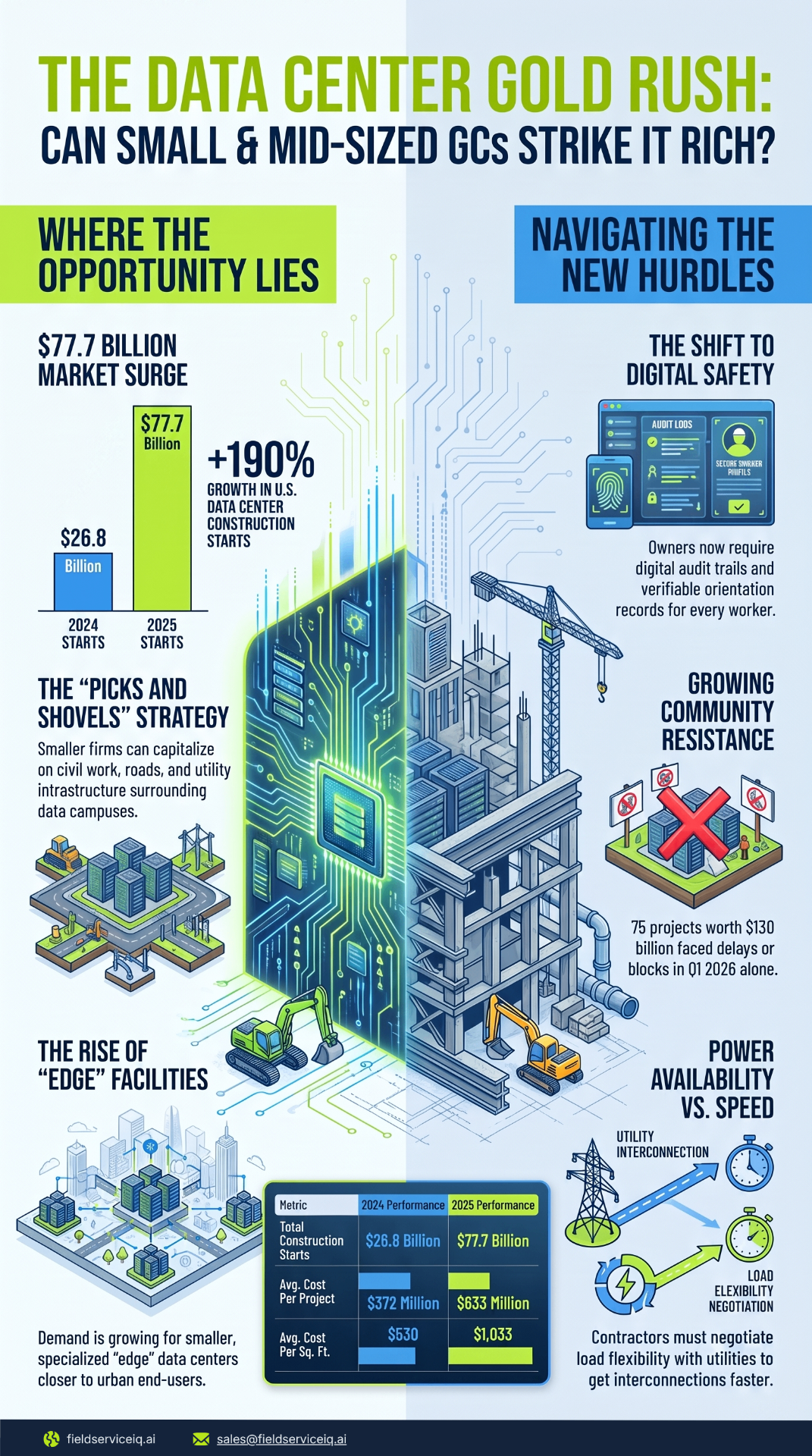
Five Infographics on the Data Center Gold Rush
The visual companion to the supercycle: spend, speed-to-power, moratoriums, and where GCs win.
Get the Free Data Center InfographicsThe Mind-Boggling Economics of the Build-Out
The 2025-2026 construction stats illustrate an industry that is attempting to build its way out of a crisis with unprecedented capital. However, these soaring costs are creating a bifurcated market, forming a financial "moat" that effectively prices smaller cloud providers out of existence. The barriers to entry are no longer just intellectual; they are purely industrial.
- →Construction Starts: Data center starts surged to $77.7 billion in 2025, a 190% year-over-year increase.
- →Square Foot Costs: Average building costs have skyrocketed to $1,033 per square foot, nearly doubling the figures from 2024.
- →Hyperscaler Spending: The "Big 4" (Google, Microsoft, Amazon, Meta) are projected to spend a collective $700 billion on AI infrastructure this year alone.
A Capital Concentration Moat
This capital concentration ensures that only the most well-capitalized players can compete for the dwindling supply of land, power, and high-end chips.
The "Loud" Reality of Local Resistance
As the "Cloud" hits the ground, it is meeting fierce resistance from the communities that host it. In Nebraska, Seward, Otoe, and Gage counties have moved toward moratoriums on new data center development. These communities are raising the alarm over water consumption, industrial noise, and the strain on local power costs.
The financial risk of this pushback is now quantifiable. In Minnesota, a judge’s halt on Google’s "Project Skyway" resulted in estimated delay costs of $5 million or more. For strategists and investors, community pushback is no longer a PR hurdle; it is a major construction risk that can render carefully planned schedules and budgets obsolete overnight.
Building the Builders
The most critical bottleneck in the AI era may not be silicon or power, but the human beings required to lay the literal bricks and mortar. You cannot build a $16 billion project like the OpenAI and Oracle "Stargate" campus in Michigan without a massive human workforce; that project alone requires roughly 700 union tradespeople working under a project labor agreement.
Recognizing that human labor is the ultimate limiting factor, the titans of the industry are pivoting their investments. Meta has earmarked $115 million for its workforce academy, while Google has pledged $50 million specifically for skilled trades training. The industry has realized that the speed of the AI supercycle is dictated by the speed at which we can train the humans who build the infrastructure.
A Cycle With No Exit?
The 2026 AI Infrastructure Supercycle has reached a point of paradox. The global demand for AI intelligence is surging, yet the physical ability to produce power and space is hitting a hard ceiling. This boom is no longer limited by capital or imagination, but by the availability of the grid and the patience of the local populace. We are re-engineering the global industrial landscape, and the trade-offs are becoming increasingly stark.
As we look toward the end of the decade, we must ask ourselves: as AI becomes as essential as electricity, what trade-offs are we willing to make to keep the engines running? Is the convenience of an all-encompassing digital intelligence worth the permanent strain on our local grids, our water supplies, and our quiet neighborhoods?
Are Data Centers a Gold Mine for GCs?
Five free infographics on the $700B AI infrastructure supercycle: designed for GC leaders evaluating the data-center opportunity.
Download the Free InfographicsSee ServiceIQ run your service operation
Dispatch, work orders, customer history, and billing on one platform, built for contractors growing past whiteboards and group texts.
Get started freeFrequently asked questions
Keep reading

The Data Center Gold Rush for Small & Mid-Sized GCs
Data center starts hit $77.7B in 2025 (+190% YoY) at $1,033 per square foot. A playbook for small and mid-sized GCs on speed-to-power, decommissioning plans, and winning a seat at the hyperscale table.

Why Agility Beats Scale
Speed-to-power beats square footage. A GC playbook for winning distributed inference builds through EPRI Class D/E flexibility, modular construction, and civil partnerships that clear community moratoriums.

The $700 Billion Ceiling
Five surprising realities behind the $700B AI infrastructure war: from Google turning Meta away to the $1,033 square foot, Nebraska moratoriums, and the loadside-breaker kill switch.
See ServiceIQ run your service operation
Dispatch, work orders, customer history, and billing on one platform, built for contractors growing past whiteboards and group texts.
Get started free