
Why Agility Beats Scale in the New Data Center Gold Rush

Quick answer: In a market where Google can’t build fast enough, the winning GC is not the biggest. It is the most agile. Speed-to-power, mastery of EPRI Class D and E flexibility, modular construction (up to 30% faster), and multi-disciplinary civil partnerships that clear community moratoriums are what unlock the pipeline. Raw scale is losing to grid intelligence.
Key Takeaways
- ●The market has flipped from capital-constrained to production-limited.
- ●The pipeline has shifted from centralized training hubs to distributed inference factories.
- ●The profit moat lives in EPRI Class D and E flexibility: sub-minute reaction to grid swings.
- ●Modular, off-site construction can compress delivery timelines by up to 30%.
- ●GCs bundling road and water improvements with data-center builds are clearing moratoriums (Amazon’s $10B Missouri campus).
- ●Hyperscalers are choosing 80% now over 100% never, flexibility is the currency.
The Bottleneck Has Flipped
The current artificial intelligence boom has reached a point of high-stakes irony: the world’s most well-capitalized companies have discovered that even infinite capital cannot buy immediate capacity. In March 2026, despite a staggering $90 billion infrastructure investment the previous year, Google was forced to inform Meta that it could not fulfill requested Gemini inference capacity. When the titans of Silicon Valley run out of "room," the industry has shifted from a capital-constrained market to a production-limited one.
For general contractors (GCs), this bottleneck represents the most significant strategic opening in a decade. The demand for compute is no longer theoretical; Google Cloud currently sits on a $460 billion performance obligation backlog. Hyperscalers are desperate for "Speed-to-Power," and the limitations of the aging power grid mean that massive, slow-moving megaprojects are frequently losing out to agile builds. Mid-sized GCs that can navigate grid complexity and local regulatory minefields are now the primary solvers of this trillion-dollar problem.
A New Type of Demand
Your firm’s project pipeline depends on mastering the shift from centralized training hubs to distributed inference factories. Training, the one-time event of building an AI model, can happen in massive, rural facilities. However, "inference" (the daily, accelerating execution of AI tasks) happens billions of times daily and requires a more distributed and responsive infrastructure footprint.
Every new AI-powered application increases the demand for inference compute, and the scale of this requirement is dwarfing previous projections.
“Nvidia CEO Jensen Huang projects agentic AI will require 1,000% more compute than generative AI within two years.”
Building for the Grid’s Edge
For a GC, this means the future of data center construction isn’t just about "bigger" warehouses; it is about building high-density, latency-sensitive facilities that can live closer to the user and the grid’s edge.
"Speed-to-Power" as the Primary Competitive Advantage
In a market where Google Cloud’s revenue is actively throttled by a lack of available capacity, Speed-to-Power is the only metric that matters. To win, your firm must build for the Electric Power Research Institute (EPRI) "Flexibility Classes." While most GCs can handle Classes A through C (managing peaks and energy shortages), the real profit moat lies in Classes D and E:
- →Class A: Supports the system during infrequent extreme stresses.
- →Class B: Manages daily or weekly demand peaks.
- →Class C: Meets long-lasting energy shortages.
- →Class D: Protects against sudden supply or demand swings.
- →Class E: Provides frequency stabilizing.
Sophisticated Controls, Not Square Footage
Unlocking the system value of Classes D and E requires more than just square footage; it requires a deep expertise in sophisticated control software and high-speed switching systems capable of reacting to grid fluctuations in under a minute. For a strategic GC, the value driver has shifted from the building shell to the complexity of the interconnection and the facility’s ability to act as a grid asset.
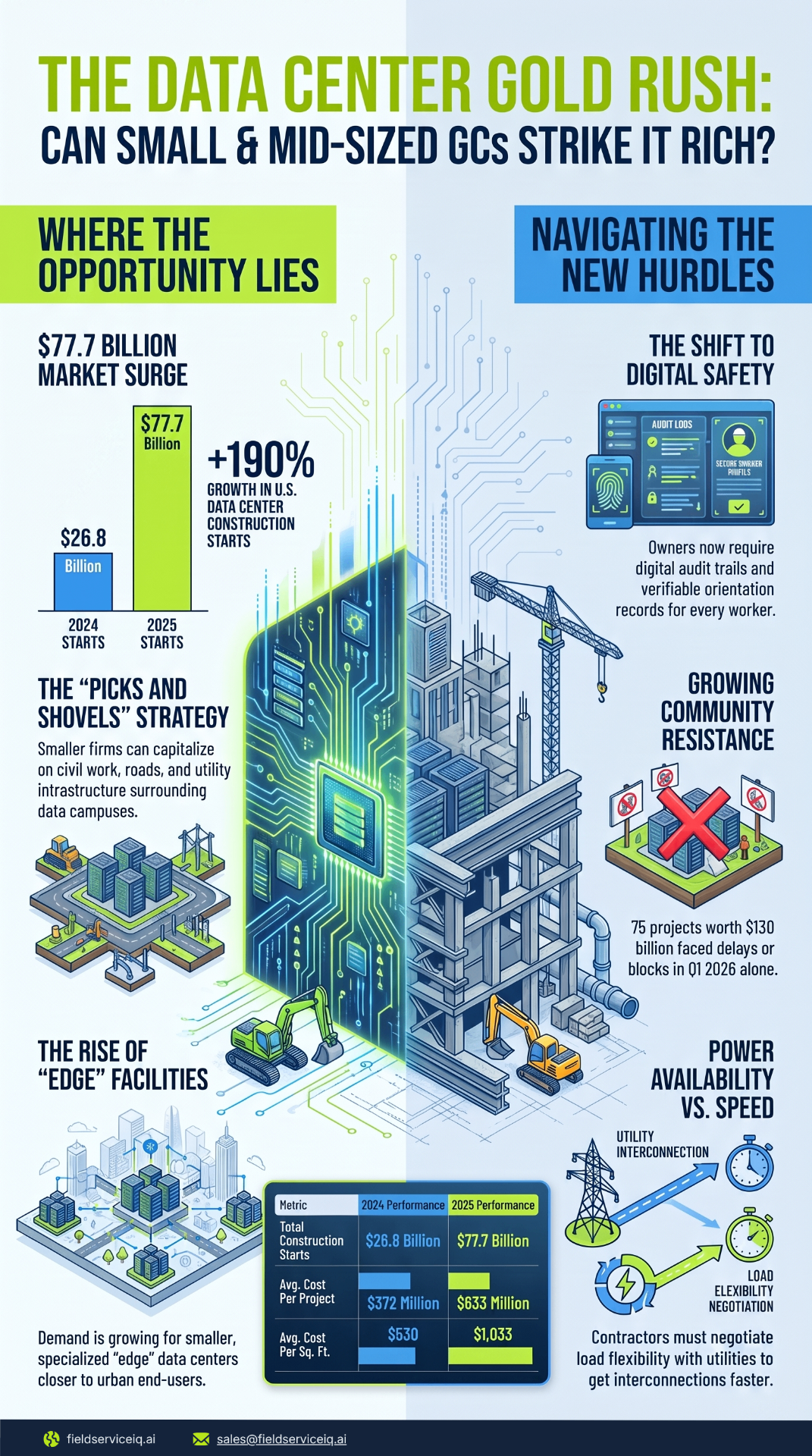
Five Infographics on the Data Center Gold Rush
The visual playbook: speed-to-power, EPRI classes, moratorium risk, and modular delivery.
Get the Free Data Center InfographicsNavigating the Moratorium Minefield
Even with the "Big 4" hyperscalers planning a collective infrastructure spend exceeding $700 billion, projects are hitting a "Local Wall." Community and regulatory pushback regarding noise, water consumption, and energy costs are resulting in unprecedented delays. In Q1 2026 alone, 75 data center projects worth $130 billion were delayed or blocked, nearly matching the total disruptions for the entire year of 2025. Seward County, Nebraska, for instance, recently enacted a one-year moratorium on new developments to weigh these concerns.
To bypass this risk, a GC must evolve into a multi-disciplinary civil partner. Take the Amazon $10 billion Missouri campus: GCs there are successfully navigating local opposition by bundling data center construction with critical improvements to local road and water infrastructure. By solving community problems, you secure your project’s timeline.
Mark Carter, a partner at law firm Buchalter, emphasizes that the danger of these delays is financial obsolescence:
“The biggest contractor risk isn’t necessarily the project gets canceled. It’s that the project gets delayed long enough that all the assumptions underlying the contractor’s price and schedule become obsolete.”
Designing for "The Aurora Template"
The 96-MW Aurora AI Factory in Virginia has established the new industry template: the flexible data center. To compete, GCs must master three pillars of workload flexibility:
- Temporal Flexibility: Designing systems where AI workloads can be slowed or paused (customer-designated) based on real-time grid stress.
- Spatial Flexibility: Developing the networking and interconnection depth required to reroute latency-sensitive loads from a power-constrained facility to another data center halfway across the country.
- Advanced AI Plant Design: Implementing cooling and IT equipment that can operate outside traditional data halls to reduce plant energy consumption.
The Modular Advantage
Pro-Tip: Adopting modular construction approaches, moving power and cooling equipment outside of the main data halls, can speed up your delivery timeline by as much as 30% and help "future-proof" the facility.
The Reality of 80%
The AI boom is currently limited by production, not interest. As the grid reaches its maximum capacity, hyperscalers face a brutal reality: they can either wait for 100% grid power that may never arrive, or they can negotiate the flexibility to get 80% of their facility online today.
The market no longer rewards simple scale. It rewards the ability to navigate local regulations and integrate deeply with the grid. The firms winning this work are not the biggest ones; they are the ones that can start in six weeks and flex their load when the utility asks.
Appendix: The Changing Landscape of Data Center Construction
| Factor | Traditional Megaprojects | The New Flexible Infrastructure |
|---|---|---|
| Primary Constraint | Land and building materials | Power availability and Interconnection |
| Construction Pace | Traditional linear timelines | Modular / Off-site (30% Faster) |
| Risk Factor | Labor shortages | Community moratoriums and grid delays |
| Value Driver | Total square footage | Grid flexibility and Speed-to-Power |
| Interconnection Depth | Passive grid connection | Active grid asset (EPRI Class D/E) |
Are Data Centers a Gold Mine for GCs?
Five free infographics on the agility-vs-scale battle in the data-center gold rush, built for GC leaders positioning to win the next round of hyperscale work.
Download the Free InfographicsReady to take on more premium projects without adding to your overhead?
Lock in your flat-rate, unlimited-user fee with ServiceIQ today.
Start your free trialFrequently asked questions
Keep reading

The Data Center Gold Rush for Small & Mid-Sized GCs
Data center starts hit $77.7B in 2025 (+190% YoY) at $1,033 per square foot. A playbook for small and mid-sized GCs on speed-to-power, decommissioning plans, and winning a seat at the hyperscale table.

The 2026 AI Infrastructure Supercycle
The cloud has hit the ground. A 2026 overview of the AI infrastructure supercycle: $700B hyperscaler spend, the training-to-inference pivot, FlexMosaic, local moratoriums, and the workforce race.
The $700 Billion Ceiling
Five surprising realities behind the $700B AI infrastructure war: from Google turning Meta away to the $1,033 square foot, Nebraska moratoriums, and the loadside-breaker kill switch.
Ready to take on more premium projects without adding to your overhead?
Lock in your flat-rate, unlimited-user fee with ServiceIQ today.
Start your free trial